Important: Please read the following documents for detailed information about this specific project:
In this project, I applied machine learning to predict geometric shapes from point cloud data captured during a milling process. Unlike traditional quality control methods that rely on post-production measurements and incur significant delays and costs, I developed a custom neural network model that precisely identifies and classifies points corresponding to basic geometric shapes—with a primary focus on detecting circles within 3D point clouds.
I designed and implemented a neural network architecture featuring multiple hidden layers with ReLU activation functions, fine-tuned hyperparameters such as learning rate, batch size, and early stopping, and managed class imbalance using balanced class weighting techniques. Trained on data from multiple production plates, my model achieved a detection accuracy of approximately 89% despite challenges like incomplete datasets.
This project not only demonstrates my technical expertise in data preprocessing, feature engineering, and neural network design, but also my ability to deploy machine learning solutions that significantly reduce production delays and operational costs.
This repository is intended to showcase my software engineering capabilities in machine learning. If you would like additional examples of implementing machine learning with neural networks, please feel free to request further implementations:
From page 32 to 36 in the main project document you will find details about my requiriments to the NN and its definition principles, including hyperparameters.
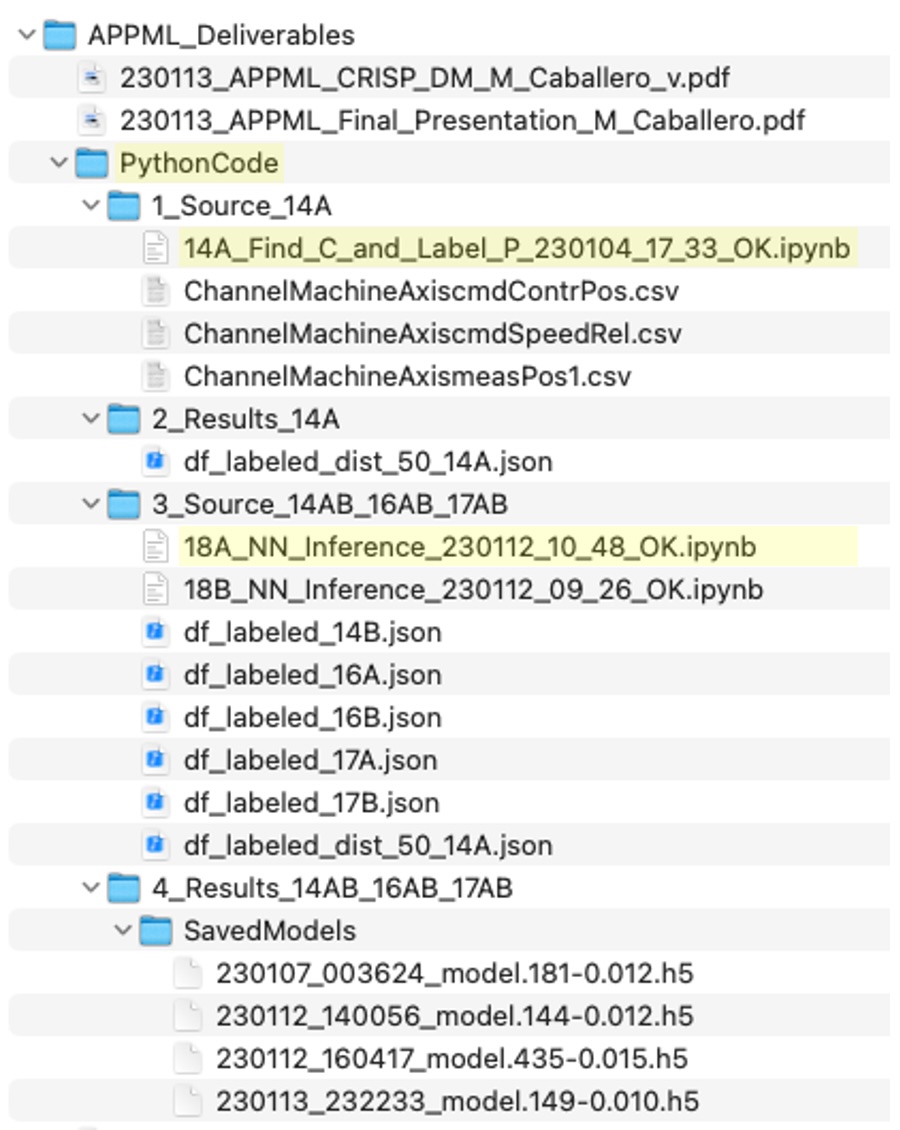
Here you find sample files from my original (desktop) file structure:
The PythonCode directory contains sample scripts demonstrating key functionality:
# Purpose of this script:
# Find Circles in a given Measuring Position Dataset: ChannelMachineAxismeasPos1
# This code can perform 2 tasks:
# 1. Train a neural network to predict circles and save the model
# 2. Use a trained neural network to predict circles on unseen data