# NXPCUP-Shield-FRDM-MCXN947 Assembly Guide
[← Back to Main](../tutorial.md) | [← Shield Components](shield-components.md)
## Assembly Steps Overview
1. [Component Preparation](#step-1-component-preparation)
2. [Soldering Resistors](#step-2-soldering-resistors-r1-r20)
3. [Soldering Capacitors](#step-3-soldering-capacitors-c1-c5)
4. [Soldering Diode](#step-4-soldering-schottky-diode-d1)
5. [Soldering IC Sockets](#step-5-soldering-ic-sockets-for-u4-u7)
6. [Soldering Header Connectors](#step-6-soldering-header-connectors-j1-j2-j5-j6)
7. [Soldering JTAG Connectors](#step-7-soldering-jtag-connectors-j7-j9)
8. [Soldering XT60 Connector](#step-8-soldering-xt60-connector-j10)
9. [Soldering Screw Terminals](#step-9-soldering-screw-terminals-j11-j12)
10. [Soldering 2-pin and 3-pin Connectors](#step-10-soldering-2-pin-and-3-pin-connectors-j13-j15-j17)
11. [Soldering Potentiometer](#step-11-soldering-potentiometer-rv1)
12. [Soldering Switch](#step-12-soldering-switch-s1)
13. [Soldering DIP Switch](#step-13-soldering-dip-switch-sw1)
14. [Mounting DC-DC Converter](#step-14-mounting-dc-dc-converter-u1)
15. [Mounting Motor Drivers](#step-15-mounting-motor-drivers-u2-u3)
16. [Inserting LM339 ICs](#step-16-inserting-lm339-integrated-circuits-u4-u7)
17. [Mounting Jumper](#step-17-mounting-jumper)
18. [Final Verification](#step-18-final-verification)
19. [PCB Cleaning](#step-19-pcb-cleaning)
---
## Before You Begin
### Safety Precautions
- Wear safety glasses when soldering
- Keep soldering iron in a safe stand when not in use
- Avoid touching the soldering iron tip
- Wash hands after handling solder (especially lead-based)
### Soldering Tips
- Use appropriate temperature (300-350°C for lead-free solder)
- Clean the tip regularly on a damp sponge
- Apply solder to the joint, not the iron
- Heat both the pad and component lead
- Use just enough solder for a shiny, cone-shaped joint
- Allow joints to cool naturally (don't blow on them)
---
## Step 1: Component Preparation
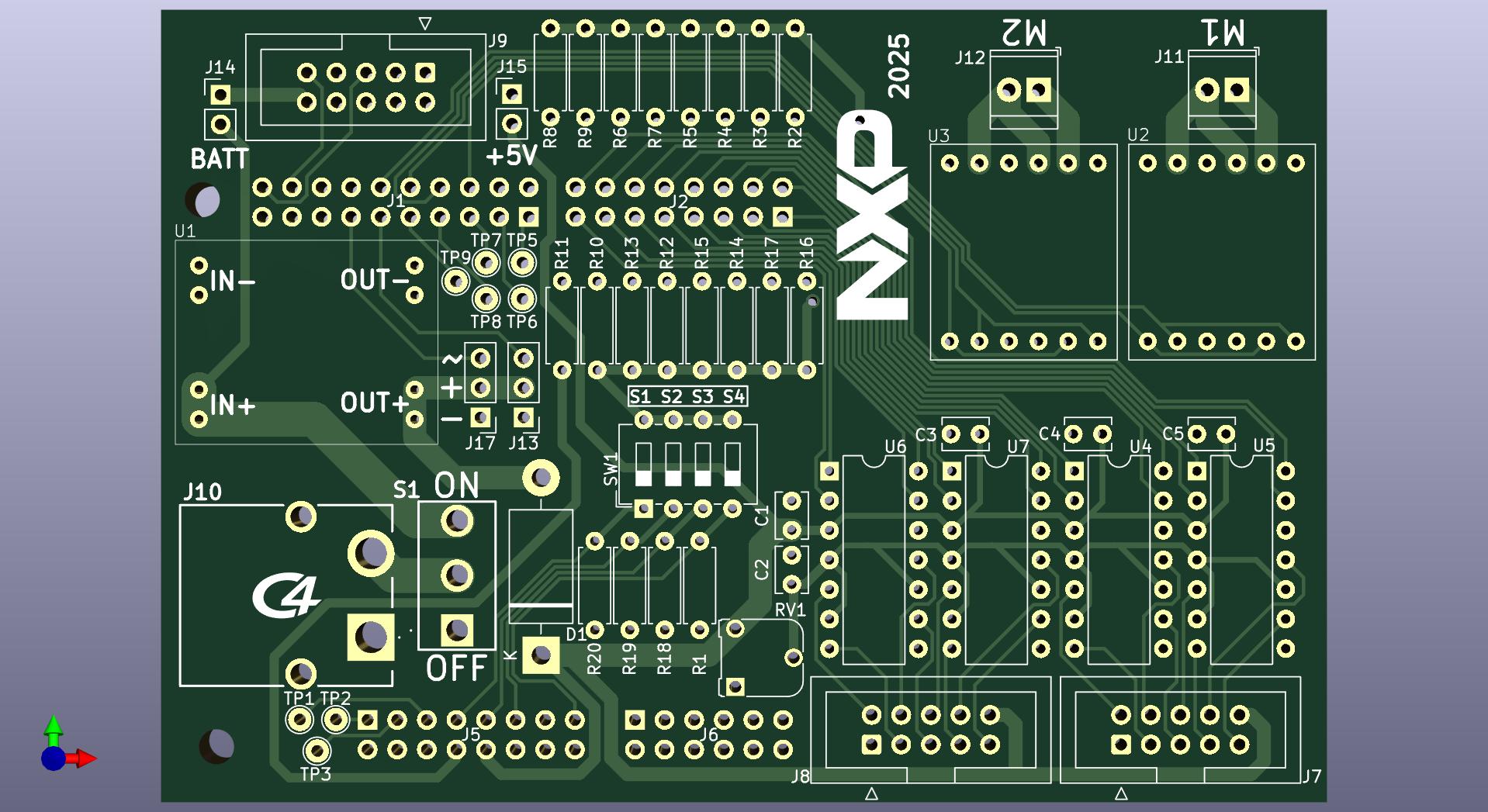 ### Checklist
Verify that you have all electronic components from the [Shield Components table](shield-components.md):
### Organize Your Workspace
1. Lay out all components in groups
2. Label small containers for cut-off leads
3. Have your tools ready and accessible
4. Ensure good lighting
5. Keep the PCB clean and free from debris
---
## Step 2: Soldering Resistors (R1-R20)
### Checklist
Verify that you have all electronic components from the [Shield Components table](shield-components.md):
### Organize Your Workspace
1. Lay out all components in groups
2. Label small containers for cut-off leads
3. Have your tools ready and accessible
4. Ensure good lighting
5. Keep the PCB clean and free from debris
---
## Step 2: Soldering Resistors (R1-R20)
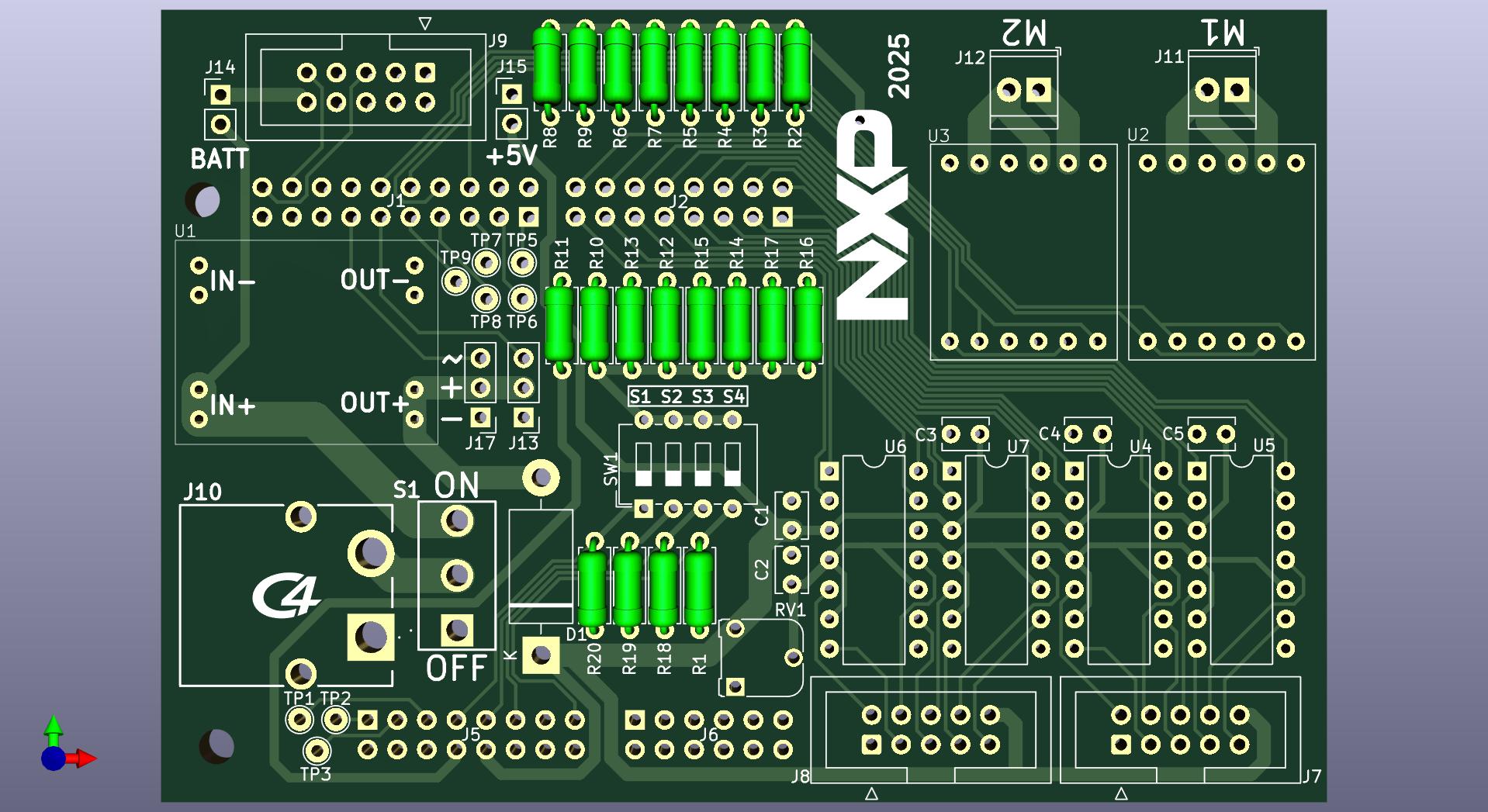 ### Instructions
1. **Identify positions** R1-R20 on the PCB silkscreen
2. **Bend the leads:**
- Use the resistor body width as a guide
- Bend leads at 90° directly next to the resistor body
3. **Insert resistors:**
- Push through the PCB holes
- Resistors can be mounted in either direction (no polarity)
- Ensure the resistor body sits flush against the PCB
4. **Secure the component:**
- Bend the leads slightly outward on the bottom to hold in place
5. **Solder the joints:**
- Heat both the pad and the lead for 2-3 seconds
- Apply solder to create a shiny, cone-shaped joint
- Remove solder first, then the iron
6. **Trim excess leads:**
- Use flush cutters to trim close to the solder joint
- Cut at a slight angle away from the joint
### Quality Check
- [ ] All 20 resistors are soldered
- [ ] Solder joints are shiny and cone-shaped
- [ ] No cold solder joints (dull, grainy appearance)
- [ ] No solder bridges between adjacent pads
- [ ] Leads are trimmed flush
**Note:** Resistors have no polarity and can be mounted in any direction.
---
## Step 3: Soldering Capacitors (C1-C5)
### Instructions
1. **Identify positions** R1-R20 on the PCB silkscreen
2. **Bend the leads:**
- Use the resistor body width as a guide
- Bend leads at 90° directly next to the resistor body
3. **Insert resistors:**
- Push through the PCB holes
- Resistors can be mounted in either direction (no polarity)
- Ensure the resistor body sits flush against the PCB
4. **Secure the component:**
- Bend the leads slightly outward on the bottom to hold in place
5. **Solder the joints:**
- Heat both the pad and the lead for 2-3 seconds
- Apply solder to create a shiny, cone-shaped joint
- Remove solder first, then the iron
6. **Trim excess leads:**
- Use flush cutters to trim close to the solder joint
- Cut at a slight angle away from the joint
### Quality Check
- [ ] All 20 resistors are soldered
- [ ] Solder joints are shiny and cone-shaped
- [ ] No cold solder joints (dull, grainy appearance)
- [ ] No solder bridges between adjacent pads
- [ ] Leads are trimmed flush
**Note:** Resistors have no polarity and can be mounted in any direction.
---
## Step 3: Soldering Capacitors (C1-C5)
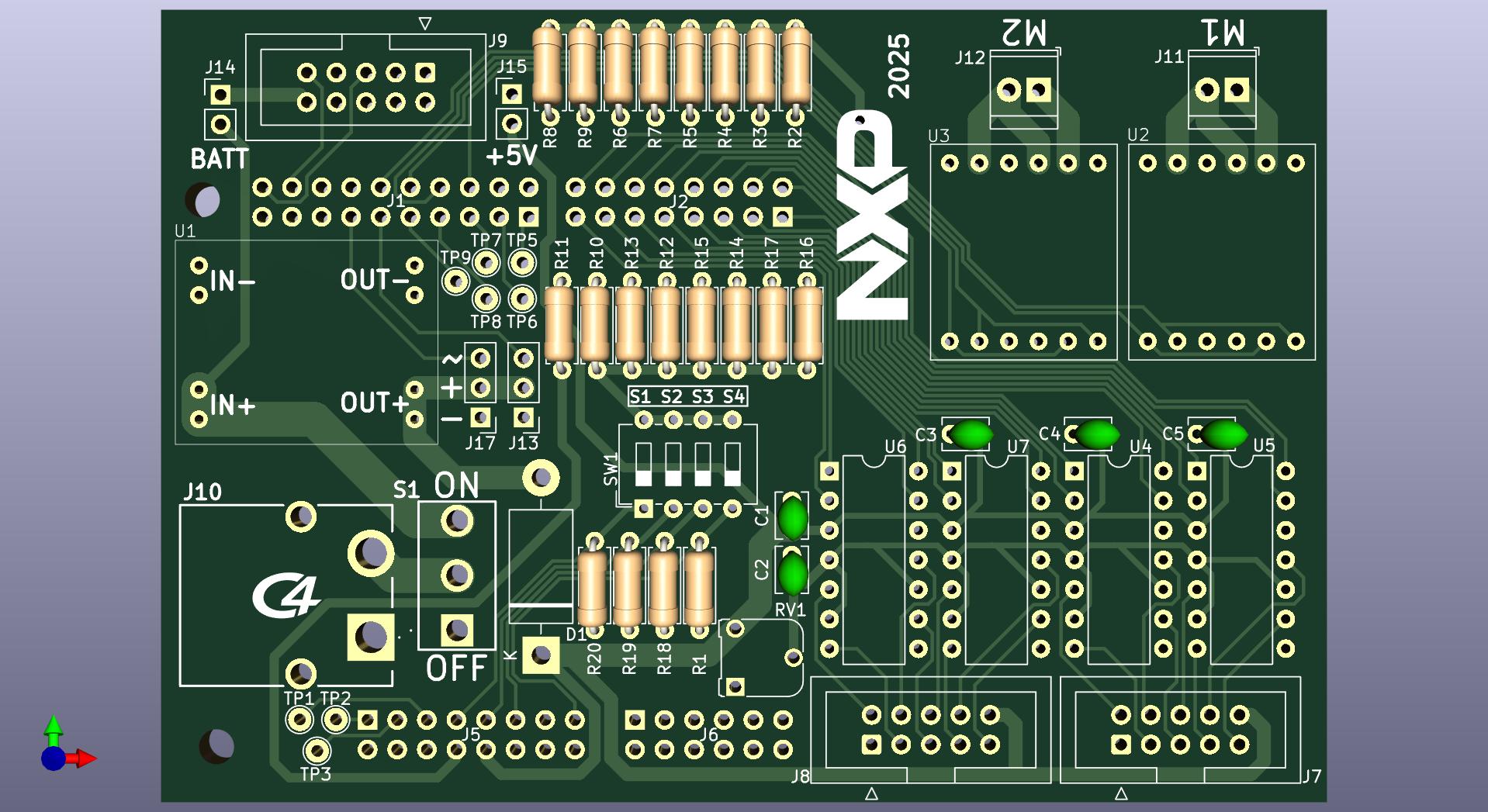 ### Instructions
1. **Identify positions** C1-C5 on the PCB
2. **Insert capacitors:**
- Ceramic capacitors have no polarity
- Insert leads through the marked holes
- Push until the capacitor body touches the PCB
3. **Secure and solder:**
- Bend leads slightly on the bottom side
- Solder each lead using the same technique as resistors
4. **Trim excess leads:**
- Cut flush with the solder joint
### Quality Check
- [ ] All 5 capacitors are soldered
- [ ] Capacitors sit flat against the PCB
- [ ] Solder joints are clean and shiny
- [ ] No excess solder or bridges
**Note:** Ceramic capacitors have no polarity.
---
## Step 4: Soldering Schottky Diode (D1)
### Instructions
1. **Identify positions** C1-C5 on the PCB
2. **Insert capacitors:**
- Ceramic capacitors have no polarity
- Insert leads through the marked holes
- Push until the capacitor body touches the PCB
3. **Secure and solder:**
- Bend leads slightly on the bottom side
- Solder each lead using the same technique as resistors
4. **Trim excess leads:**
- Cut flush with the solder joint
### Quality Check
- [ ] All 5 capacitors are soldered
- [ ] Capacitors sit flat against the PCB
- [ ] Solder joints are clean and shiny
- [ ] No excess solder or bridges
**Note:** Ceramic capacitors have no polarity.
---
## Step 4: Soldering Schottky Diode (D1)
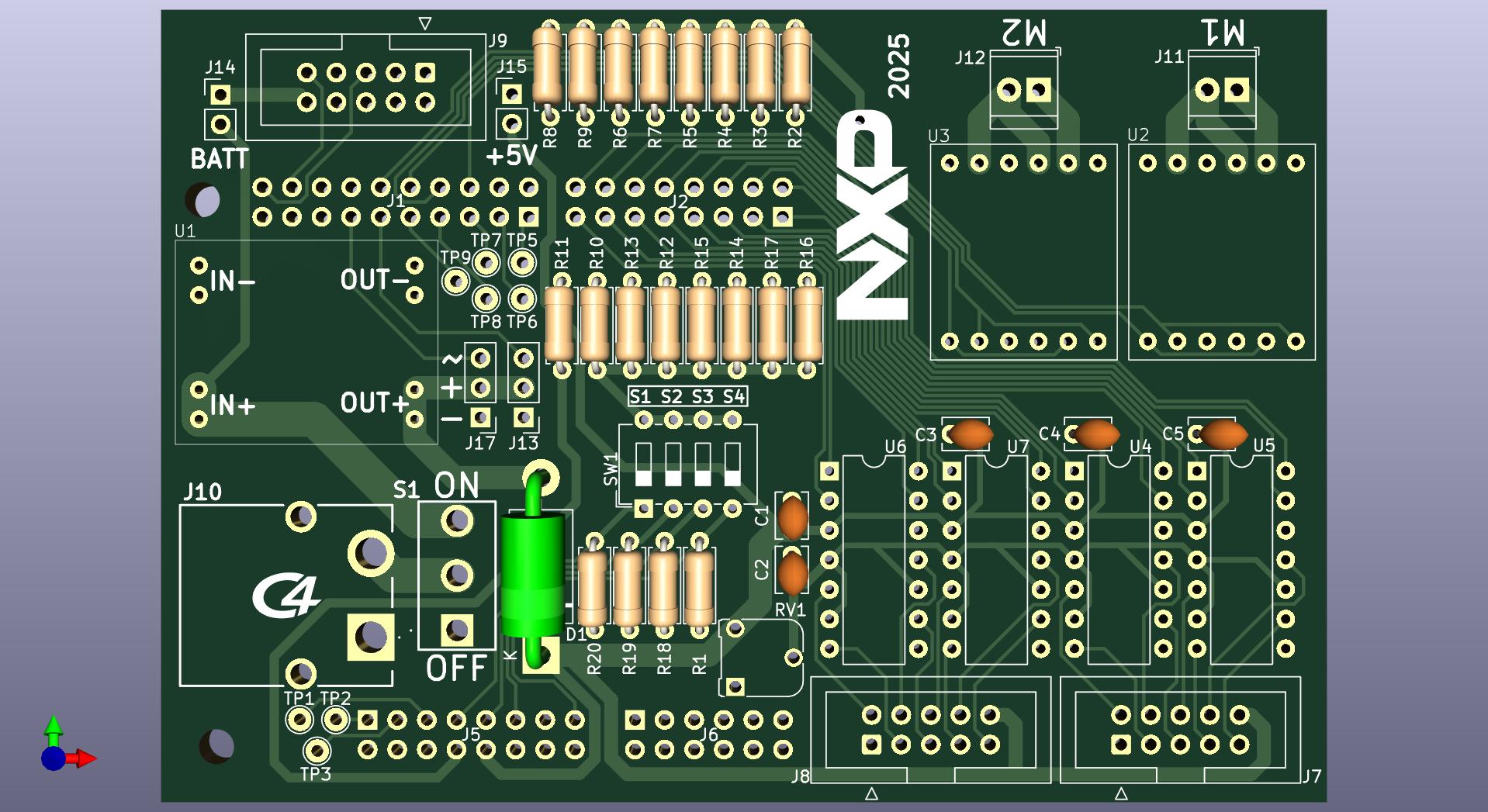 ### Instructions
1. **Identify position** D1 on the PCB
2. **⚠️ CHECK POLARITY:**
- The diode has a **band** marking on one end (cathode)
- The PCB has a corresponding marking (usually a line or band)
- **The band on the diode MUST match the marking on the PCB**
3. **Insert the diode:**
- Align the band with the PCB marking
- Double-check orientation before soldering
- Push the diode body close to the PCB
4. **Solder the leads:**
- Solder both leads securely
5. **Trim excess leads**
### Quality Check
- [ ] Diode polarity is correct (band matches PCB marking)
- [ ] Both leads are soldered properly
- [ ] Diode body is close to PCB surface
**⚠️ CRITICAL:** Incorrect diode orientation will prevent the circuit from working and may cause damage!
---
## Step 5: Soldering IC Sockets (for U4-U7)
### Instructions
1. **Identify position** D1 on the PCB
2. **⚠️ CHECK POLARITY:**
- The diode has a **band** marking on one end (cathode)
- The PCB has a corresponding marking (usually a line or band)
- **The band on the diode MUST match the marking on the PCB**
3. **Insert the diode:**
- Align the band with the PCB marking
- Double-check orientation before soldering
- Push the diode body close to the PCB
4. **Solder the leads:**
- Solder both leads securely
5. **Trim excess leads**
### Quality Check
- [ ] Diode polarity is correct (band matches PCB marking)
- [ ] Both leads are soldered properly
- [ ] Diode body is close to PCB surface
**⚠️ CRITICAL:** Incorrect diode orientation will prevent the circuit from working and may cause damage!
---
## Step 5: Soldering IC Sockets (for U4-U7)
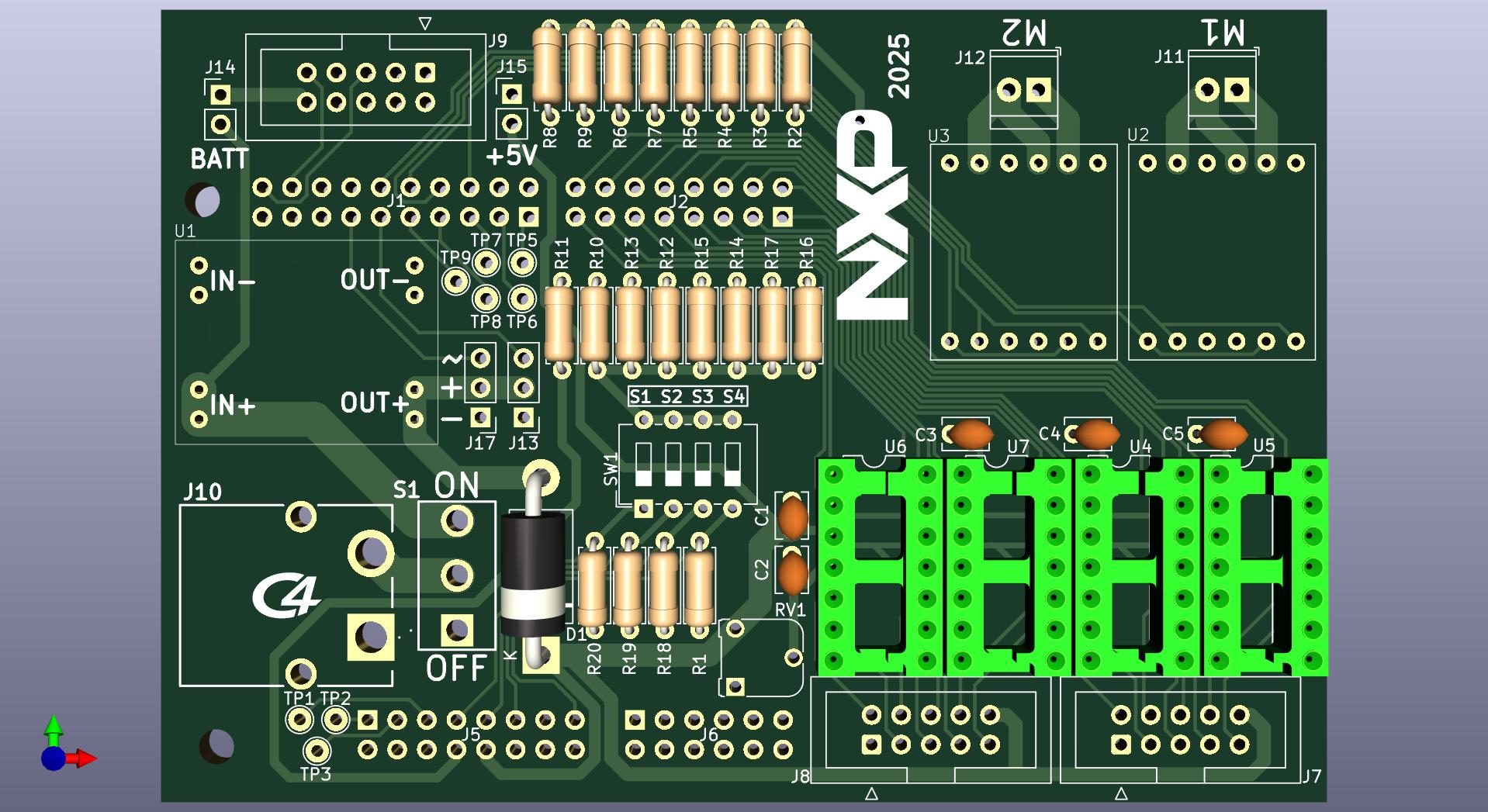 ### Instructions
1. **Identify positions** U4-U7 on the PCB
2. **Orient the sockets:**
- Each socket has a **notch** or **dot** indicating pin 1
- Match this with the marking on the PCB
- **⚠️ Correct orientation is critical!**
3. **Insert sockets:**
- Place socket into the PCB holes
- Ensure all pins go through the holes (check for bent pins)
- Socket should sit flat against the PCB
4. **Secure the socket:**
- You can tape the socket in place or use helping hands
- Solder one corner pin first
- Check alignment, reheat if needed to adjust
5. **Solder all pins:**
- Solder the opposite corner pin
- Then solder all remaining pins (14 pins per socket)
- Ensure each pin has a good solder joint
### Quality Check
- [ ] All 4 sockets (U4-U7) are installed
- [ ] Socket notches match PCB markings
- [ ] Sockets sit flat and perpendicular to PCB
- [ ] All 56 pins (14 pins × 4 sockets) are soldered
- [ ] No solder bridges between pins
**Note:** Do NOT insert the LM339 integrated circuits into the sockets yet. This will be done in Step 16.
---
## Step 6: Soldering Header Connectors (J1, J2, J5, J6)
### Instructions
1. **Identify positions** U4-U7 on the PCB
2. **Orient the sockets:**
- Each socket has a **notch** or **dot** indicating pin 1
- Match this with the marking on the PCB
- **⚠️ Correct orientation is critical!**
3. **Insert sockets:**
- Place socket into the PCB holes
- Ensure all pins go through the holes (check for bent pins)
- Socket should sit flat against the PCB
4. **Secure the socket:**
- You can tape the socket in place or use helping hands
- Solder one corner pin first
- Check alignment, reheat if needed to adjust
5. **Solder all pins:**
- Solder the opposite corner pin
- Then solder all remaining pins (14 pins per socket)
- Ensure each pin has a good solder joint
### Quality Check
- [ ] All 4 sockets (U4-U7) are installed
- [ ] Socket notches match PCB markings
- [ ] Sockets sit flat and perpendicular to PCB
- [ ] All 56 pins (14 pins × 4 sockets) are soldered
- [ ] No solder bridges between pins
**Note:** Do NOT insert the LM339 integrated circuits into the sockets yet. This will be done in Step 16.
---
## Step 6: Soldering Header Connectors (J1, J2, J5, J6)
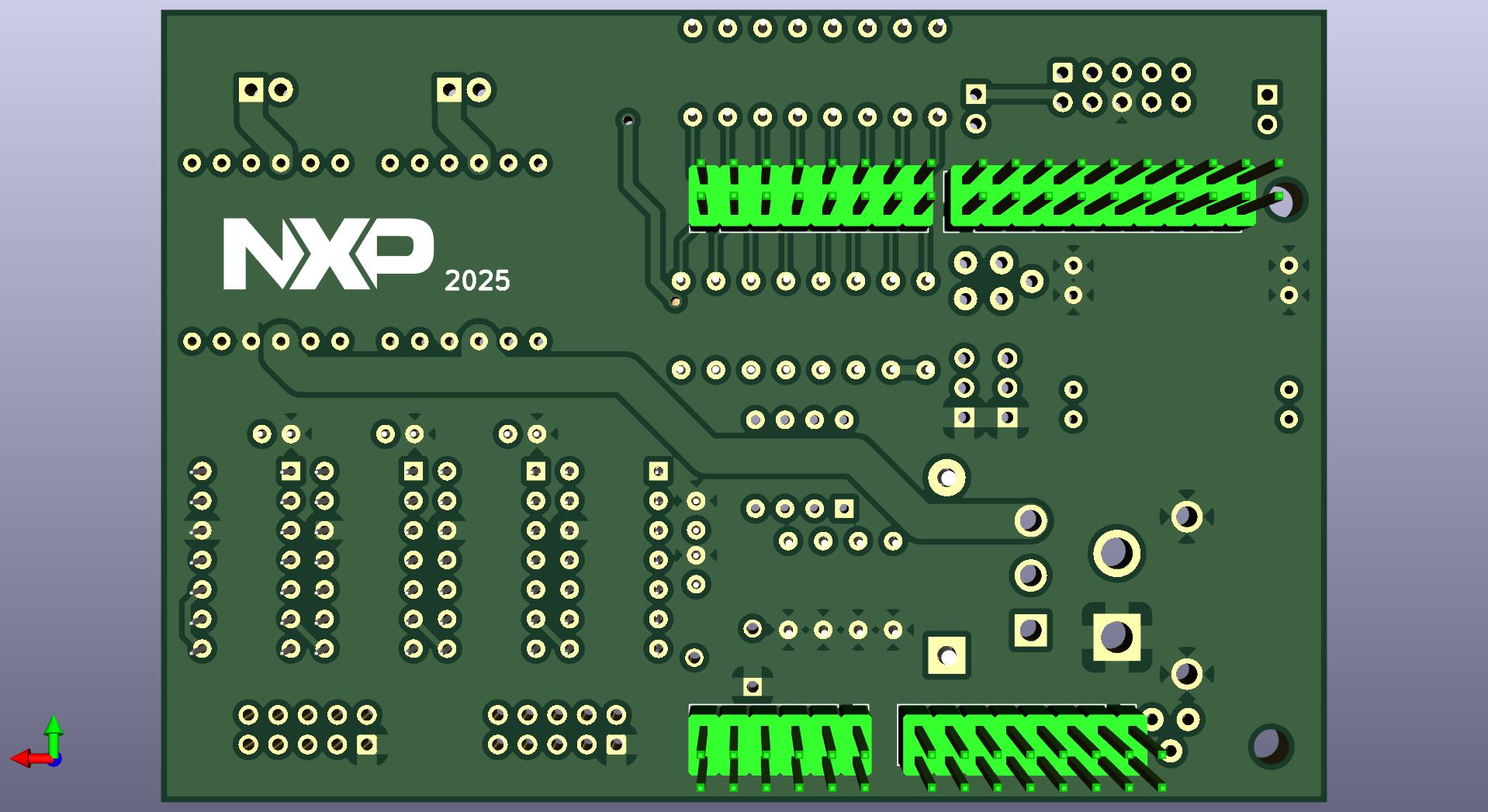 ### J1 - 2x10 Pin Connector
1. **Identify position** J1 on the PCB
2. **Insert the connector:**
- Align all 20 pins with the holes
- Ensure the connector is perpendicular to the PCB
- The plastic base should sit flush on the PCB
3. **Secure the connector:**
- Solder one corner pin
- Check alignment and adjust if needed
- Solder the opposite corner pin
4. **Solder all pins:**
- Solder all remaining 18 pins
- Ensure good solder flow on each pin
### J2, J5 - 2x8 Pin Connectors
1. **Identify positions** J2 and J5
2. **Insert each connector** (16 pins per connector)
3. **Solder using the same technique:**
- Corner pins first for alignment
- Then all remaining pins
### J6 - 2x6 Pin Connector
1. **Identify position** J6
2. **Insert the connector** (12 pins)
3. **Solder all pins**
### Quality Check
- [ ] J1 (2x10) is soldered - 20 pins
- [ ] J2 (2x8) is soldered - 16 pins
- [ ] J5 (2x8) is soldered - 16 pins
- [ ] J6 (2x6) is soldered - 12 pins
- [ ] All connectors are perpendicular to PCB
- [ ] No solder bridges between pins
- [ ] All pins have good solder joints
**Tip:** These connectors will mate with the FRDM-MCXN947 board, so proper alignment is crucial.
---
## Step 7: Soldering JTAG Connectors (J7-J9)
### J1 - 2x10 Pin Connector
1. **Identify position** J1 on the PCB
2. **Insert the connector:**
- Align all 20 pins with the holes
- Ensure the connector is perpendicular to the PCB
- The plastic base should sit flush on the PCB
3. **Secure the connector:**
- Solder one corner pin
- Check alignment and adjust if needed
- Solder the opposite corner pin
4. **Solder all pins:**
- Solder all remaining 18 pins
- Ensure good solder flow on each pin
### J2, J5 - 2x8 Pin Connectors
1. **Identify positions** J2 and J5
2. **Insert each connector** (16 pins per connector)
3. **Solder using the same technique:**
- Corner pins first for alignment
- Then all remaining pins
### J6 - 2x6 Pin Connector
1. **Identify position** J6
2. **Insert the connector** (12 pins)
3. **Solder all pins**
### Quality Check
- [ ] J1 (2x10) is soldered - 20 pins
- [ ] J2 (2x8) is soldered - 16 pins
- [ ] J5 (2x8) is soldered - 16 pins
- [ ] J6 (2x6) is soldered - 12 pins
- [ ] All connectors are perpendicular to PCB
- [ ] No solder bridges between pins
- [ ] All pins have good solder joints
**Tip:** These connectors will mate with the FRDM-MCXN947 board, so proper alignment is crucial.
---
## Step 7: Soldering JTAG Connectors (J7-J9)
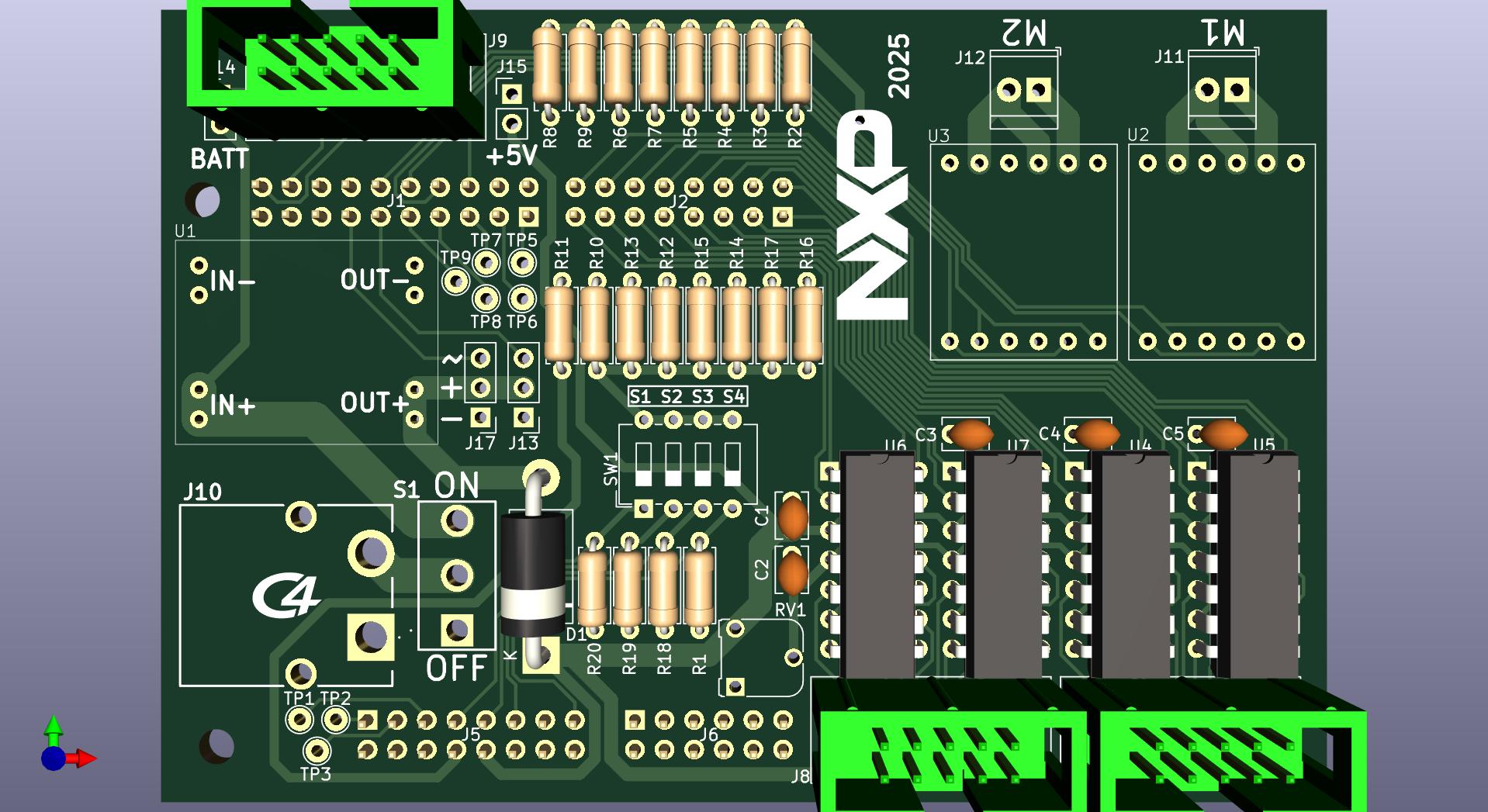 ### Instructions
1. **Identify positions** J7, J8, J9 on the PCB
2. **Check orientation:**
- JTAG connectors typically have a **pin 1 indicator**
- Match this with the PCB marking (usually a square pad or marking)
3. **Insert connectors:**
- Each connector has 2x5 pins (10 pins total)
- Ensure all pins align with holes
- Connectors should be perpendicular to the PCB
4. **Solder each connector:**
- Solder one corner pin first
- Check alignment
- Solder opposite corner
- Solder all remaining pins (10 pins per connector)
### Quality Check
- [ ] All 3 JTAG connectors (J7-J9) are installed
- [ ] Pin 1 orientation is correct on each
- [ ] Connectors are perpendicular to PCB
- [ ] All 30 pins (10 pins × 3 connectors) are soldered
- [ ] No solder bridges
**Note:** J7 and J8 are used for line sensor connections, J9 is used for camera connection.
---
## Step 8: Soldering XT60 Connector (J10)
### Instructions
1. **Identify positions** J7, J8, J9 on the PCB
2. **Check orientation:**
- JTAG connectors typically have a **pin 1 indicator**
- Match this with the PCB marking (usually a square pad or marking)
3. **Insert connectors:**
- Each connector has 2x5 pins (10 pins total)
- Ensure all pins align with holes
- Connectors should be perpendicular to the PCB
4. **Solder each connector:**
- Solder one corner pin first
- Check alignment
- Solder opposite corner
- Solder all remaining pins (10 pins per connector)
### Quality Check
- [ ] All 3 JTAG connectors (J7-J9) are installed
- [ ] Pin 1 orientation is correct on each
- [ ] Connectors are perpendicular to PCB
- [ ] All 30 pins (10 pins × 3 connectors) are soldered
- [ ] No solder bridges
**Note:** J7 and J8 are used for line sensor connections, J9 is used for camera connection.
---
## Step 8: Soldering XT60 Connector (J10)
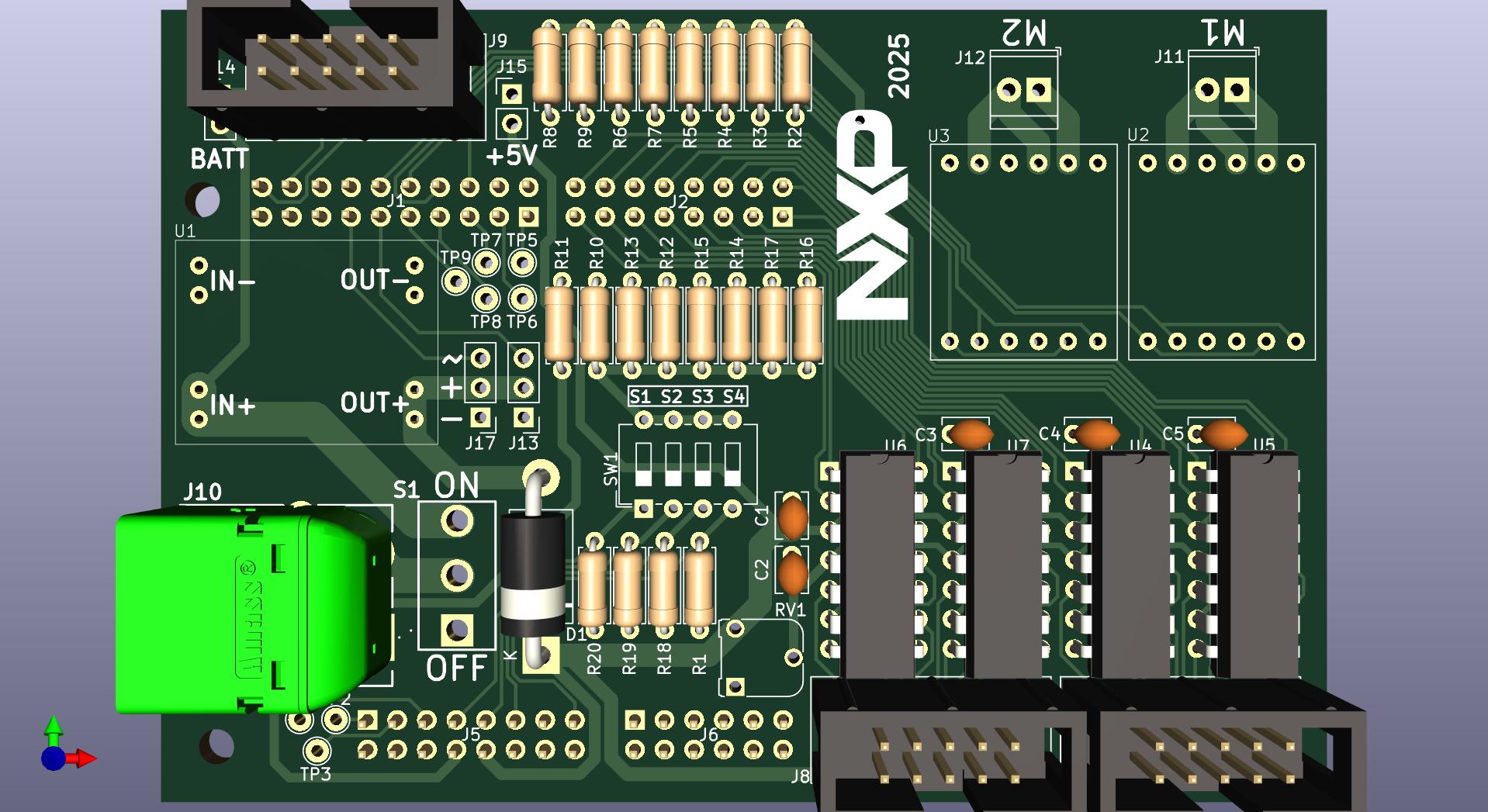 ### Instructions
1. **Identify position** J10 on the PCB
2. **⚠️ CHECK POLARITY:**
- XT60 connectors have **+ (positive)** and **- (negative)** markings
- The PCB will have corresponding markings
- **Verify correct orientation before soldering!**
3. **Insert the connector:**
- Align the connector with the PCB holes
- Ensure it sits flush against the PCB
- The connector body should be stable
4. **Solder the pins:**
- XT60 pins are large and require more heat
- Heat the pin and pad for 3-5 seconds
- Apply sufficient solder for a strong joint
- Both pins must be solidly soldered
### Quality Check
- [ ] XT60 connector polarity is correct (+ and - match PCB)
- [ ] Connector sits flush on PCB
- [ ] Both pins have strong, shiny solder joints
- [ ] No cold solder joints (these carry high current)
**⚠️ CRITICAL:** This connector carries battery power. Incorrect polarity or poor solder joints can cause serious damage or fire hazard!
---
## Step 9: Soldering Screw Terminals (J11, J12)
### Instructions
1. **Identify position** J10 on the PCB
2. **⚠️ CHECK POLARITY:**
- XT60 connectors have **+ (positive)** and **- (negative)** markings
- The PCB will have corresponding markings
- **Verify correct orientation before soldering!**
3. **Insert the connector:**
- Align the connector with the PCB holes
- Ensure it sits flush against the PCB
- The connector body should be stable
4. **Solder the pins:**
- XT60 pins are large and require more heat
- Heat the pin and pad for 3-5 seconds
- Apply sufficient solder for a strong joint
- Both pins must be solidly soldered
### Quality Check
- [ ] XT60 connector polarity is correct (+ and - match PCB)
- [ ] Connector sits flush on PCB
- [ ] Both pins have strong, shiny solder joints
- [ ] No cold solder joints (these carry high current)
**⚠️ CRITICAL:** This connector carries battery power. Incorrect polarity or poor solder joints can cause serious damage or fire hazard!
---
## Step 9: Soldering Screw Terminals (J11, J12)
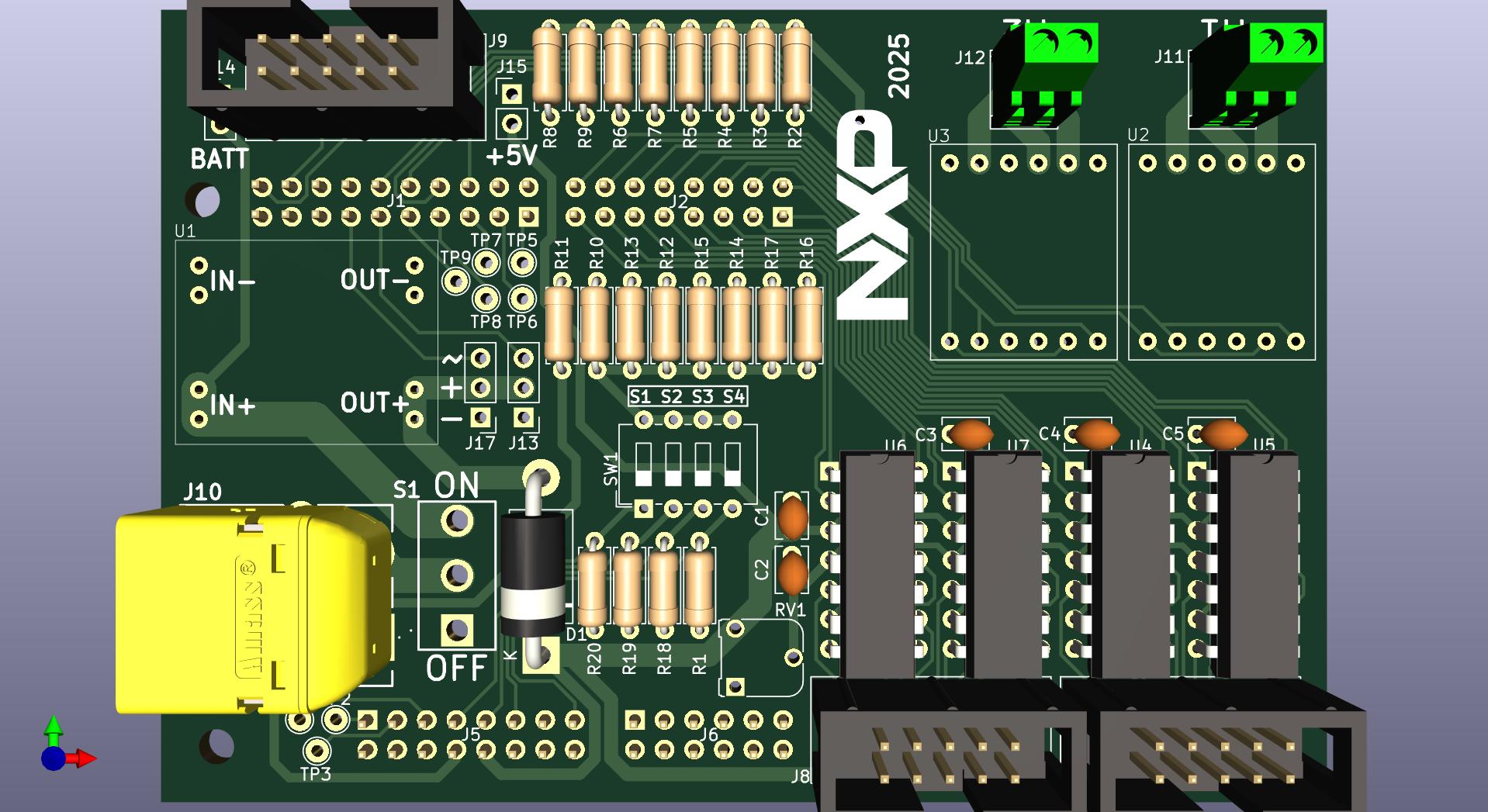 ### Instructions
1. **Identify positions** J11 and J12 on the PCB
2. **Orient the terminals:**
- The screw holes should face **outward** (away from the PCB center)
- This allows easy access for connecting motor wires
3. **Insert terminals:**
- Push the pins through the PCB holes
- Ensure the terminal body sits flat on the PCB
4. **Solder the pins:**
- Solder each pin (2 pins per terminal)
- These terminals carry motor current, so ensure good joints
### Quality Check
- [ ] Both screw terminals (J11, J12) are installed
- [ ] Screw holes face outward for easy access
- [ ] All 4 pins (2 per terminal) are soldered
- [ ] Terminals sit flat on PCB
**Note:** These terminals will connect to the DC motors.
---
## Step 10: Soldering 2-pin and 3-pin Connectors (J13-J15, J17)
### Instructions
1. **Identify positions** J11 and J12 on the PCB
2. **Orient the terminals:**
- The screw holes should face **outward** (away from the PCB center)
- This allows easy access for connecting motor wires
3. **Insert terminals:**
- Push the pins through the PCB holes
- Ensure the terminal body sits flat on the PCB
4. **Solder the pins:**
- Solder each pin (2 pins per terminal)
- These terminals carry motor current, so ensure good joints
### Quality Check
- [ ] Both screw terminals (J11, J12) are installed
- [ ] Screw holes face outward for easy access
- [ ] All 4 pins (2 per terminal) are soldered
- [ ] Terminals sit flat on PCB
**Note:** These terminals will connect to the DC motors.
---
## Step 10: Soldering 2-pin and 3-pin Connectors (J13-J15, J17)
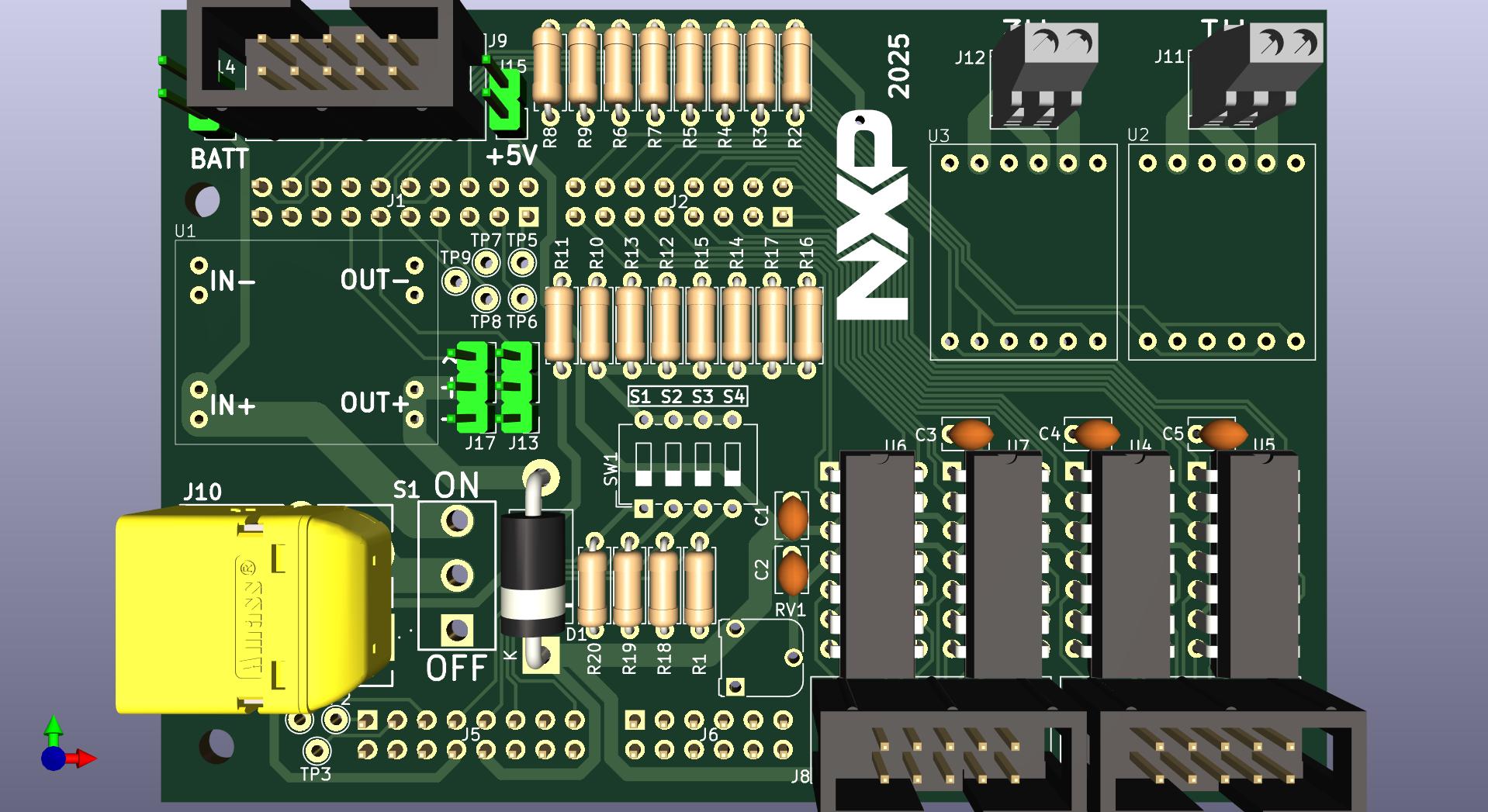 ### Instructions
1. **Identify positions:**
- J13: 3-pin connector
- J14: 2-pin connector
- J15: 2-pin connector
- J17: 3-pin connector
2. **Insert each connector:**
- Align pins with PCB holes
- Ensure connectors are perpendicular
3. **Solder all pins:**
- J13: 3 pins
- J14: 2 pins
- J15: 2 pins
- J17: 3 pins
### Quality Check
- [ ] J13 (3-pin) is soldered
- [ ] J14 (2-pin) is soldered
- [ ] J15 (2-pin) is soldered
- [ ] J17 (3-pin) is soldered
- [ ] All connectors are perpendicular to PCB
- [ ] Total 10 pins soldered
---
## Step 11: Soldering Potentiometer (RV1)
### Instructions
1. **Identify positions:**
- J13: 3-pin connector
- J14: 2-pin connector
- J15: 2-pin connector
- J17: 3-pin connector
2. **Insert each connector:**
- Align pins with PCB holes
- Ensure connectors are perpendicular
3. **Solder all pins:**
- J13: 3 pins
- J14: 2 pins
- J15: 2 pins
- J17: 3 pins
### Quality Check
- [ ] J13 (3-pin) is soldered
- [ ] J14 (2-pin) is soldered
- [ ] J15 (2-pin) is soldered
- [ ] J17 (3-pin) is soldered
- [ ] All connectors are perpendicular to PCB
- [ ] Total 10 pins soldered
---
## Step 11: Soldering Potentiometer (RV1)
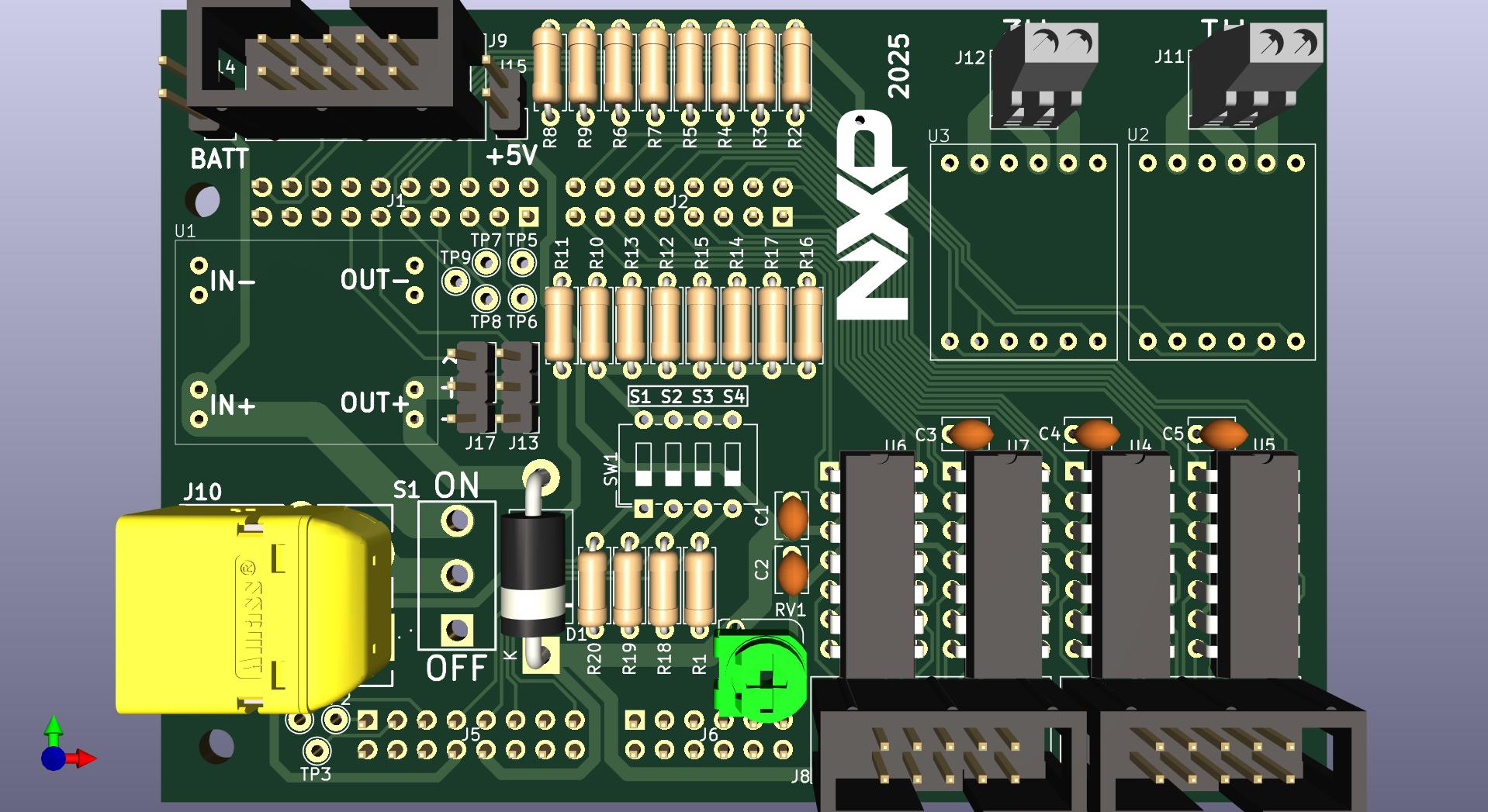 ### Instructions
1. **Identify position** RV1 on the PCB
2. **Insert the potentiometer:**
- Align the 3 pins with the PCB holes
- The adjustment screw should be accessible
- Push until the body sits on the PCB
3. **Solder the 3 pins:**
- Ensure good solder joints on all pins
### Quality Check
- [ ] Potentiometer is installed at RV1
- [ ] All 3 pins are soldered
- [ ] Adjustment screw is accessible
- [ ] Component sits flat on PCB
**Note:** This potentiometer adjusts the line sensor detection threshold.
---
## Step 12: Soldering Switch (S1)
### Instructions
1. **Identify position** RV1 on the PCB
2. **Insert the potentiometer:**
- Align the 3 pins with the PCB holes
- The adjustment screw should be accessible
- Push until the body sits on the PCB
3. **Solder the 3 pins:**
- Ensure good solder joints on all pins
### Quality Check
- [ ] Potentiometer is installed at RV1
- [ ] All 3 pins are soldered
- [ ] Adjustment screw is accessible
- [ ] Component sits flat on PCB
**Note:** This potentiometer adjusts the line sensor detection threshold.
---
## Step 12: Soldering Switch (S1)
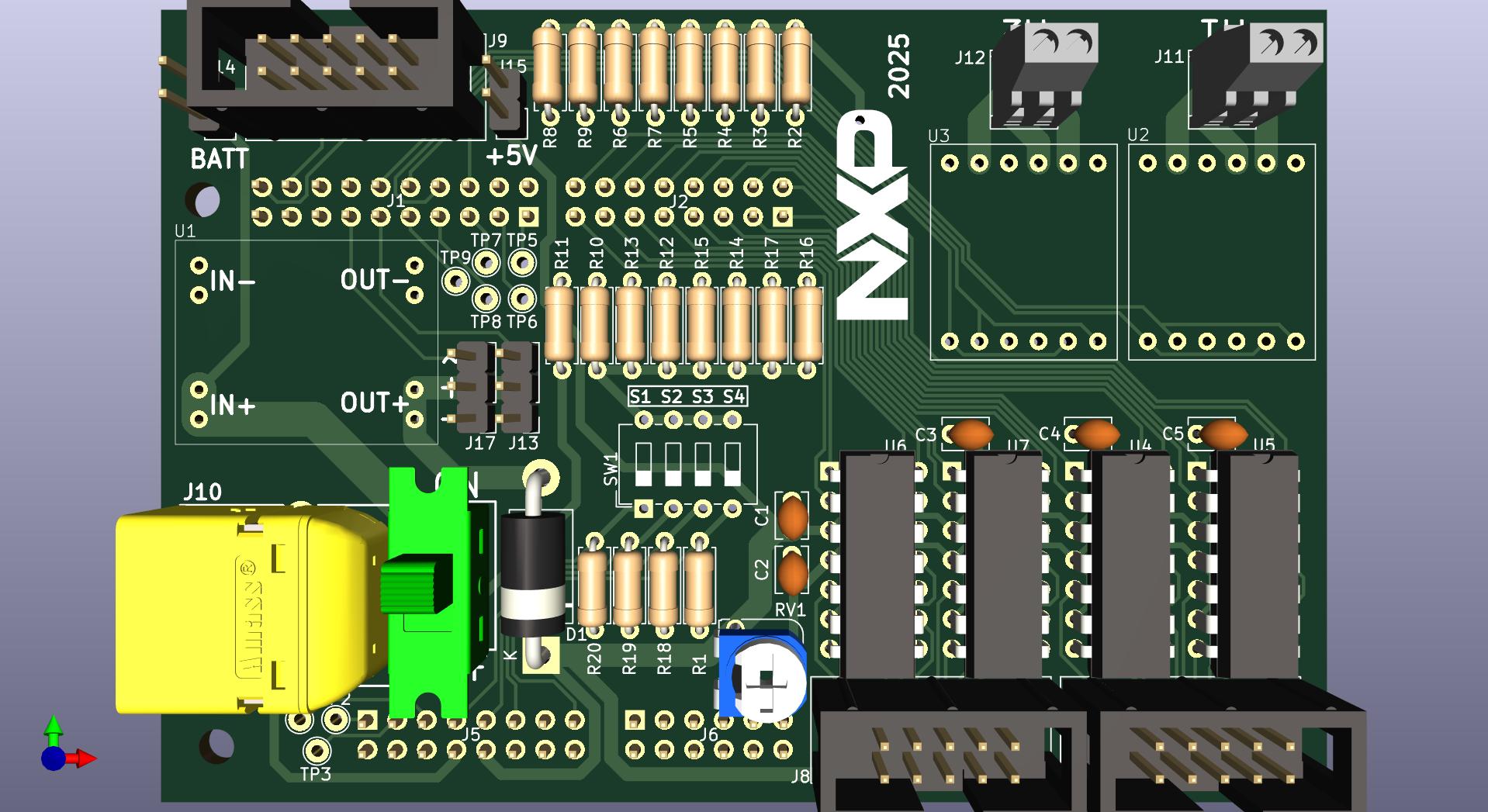 ### Instructions
1. **Identify position** S1 on the PCB
2. **Insert the slide switch:**
- Align the pins with the PCB holes
- Ensure correct orientation
- The switch should sit flat on the PCB
3. **Solder all pins:**
- Solder each pin securely
- This is the main power switch, so good joints are important
### Quality Check
- [ ] Switch is installed at S1
- [ ] All pins are soldered
- [ ] Switch operates smoothly
- [ ] Switch sits flat on PCB
**Note:** This is the main power on/off switch for the shield.
---
## Step 13: Soldering DIP Switch (SW1)
### Instructions
1. **Identify position** S1 on the PCB
2. **Insert the slide switch:**
- Align the pins with the PCB holes
- Ensure correct orientation
- The switch should sit flat on the PCB
3. **Solder all pins:**
- Solder each pin securely
- This is the main power switch, so good joints are important
### Quality Check
- [ ] Switch is installed at S1
- [ ] All pins are soldered
- [ ] Switch operates smoothly
- [ ] Switch sits flat on PCB
**Note:** This is the main power on/off switch for the shield.
---
## Step 13: Soldering DIP Switch (SW1)
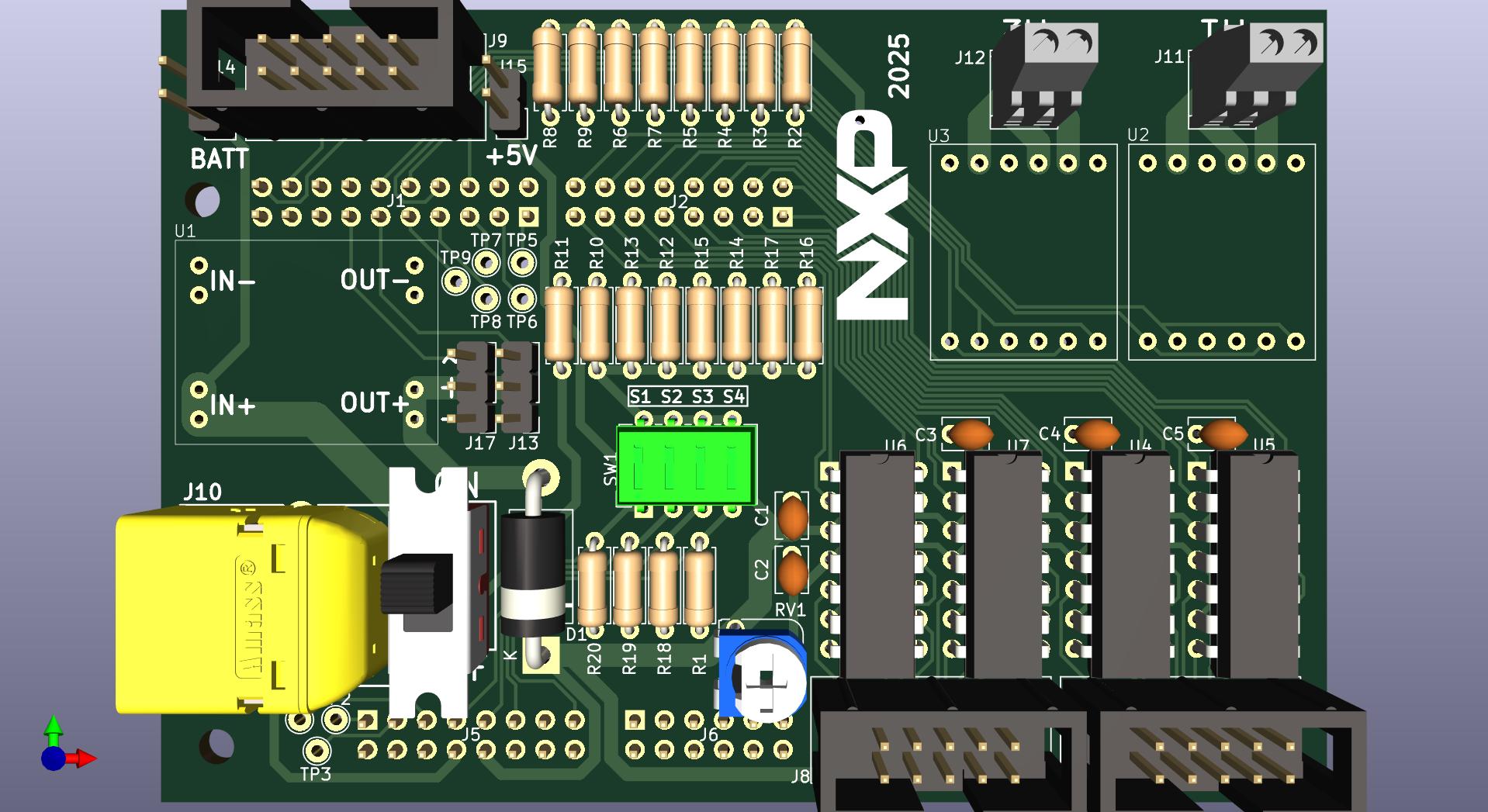 ### Instructions
1. **Identify position** SW1 on the PCB
2. **Check orientation:**
- DIP switches usually have a marking for position 1
- Match this with the PCB marking
3. **Insert the DIP switch:**
- Align all 8 pins with the PCB holes
- Ensure the switch sits flat
4. **Solder all 8 pins:**
- Solder one corner pin first
- Check alignment
- Solder remaining pins
### Quality Check
- [ ] DIP switch is installed at SW1
- [ ] Correct orientation (position 1 marked)
- [ ] All 8 pins are soldered
- [ ] Switch sits flat on PCB
- [ ] All 4 switches operate smoothly
**Note:** This 4-position DIP switch is used for configuration settings.(keep position 3 in ON state, do not use)
---
## Step 14: Mounting DC-DC Converter (U1)
### Instructions
1. **Identify position** SW1 on the PCB
2. **Check orientation:**
- DIP switches usually have a marking for position 1
- Match this with the PCB marking
3. **Insert the DIP switch:**
- Align all 8 pins with the PCB holes
- Ensure the switch sits flat
4. **Solder all 8 pins:**
- Solder one corner pin first
- Check alignment
- Solder remaining pins
### Quality Check
- [ ] DIP switch is installed at SW1
- [ ] Correct orientation (position 1 marked)
- [ ] All 8 pins are soldered
- [ ] Switch sits flat on PCB
- [ ] All 4 switches operate smoothly
**Note:** This 4-position DIP switch is used for configuration settings.(keep position 3 in ON state, do not use)
---
## Step 14: Mounting DC-DC Converter (U1)
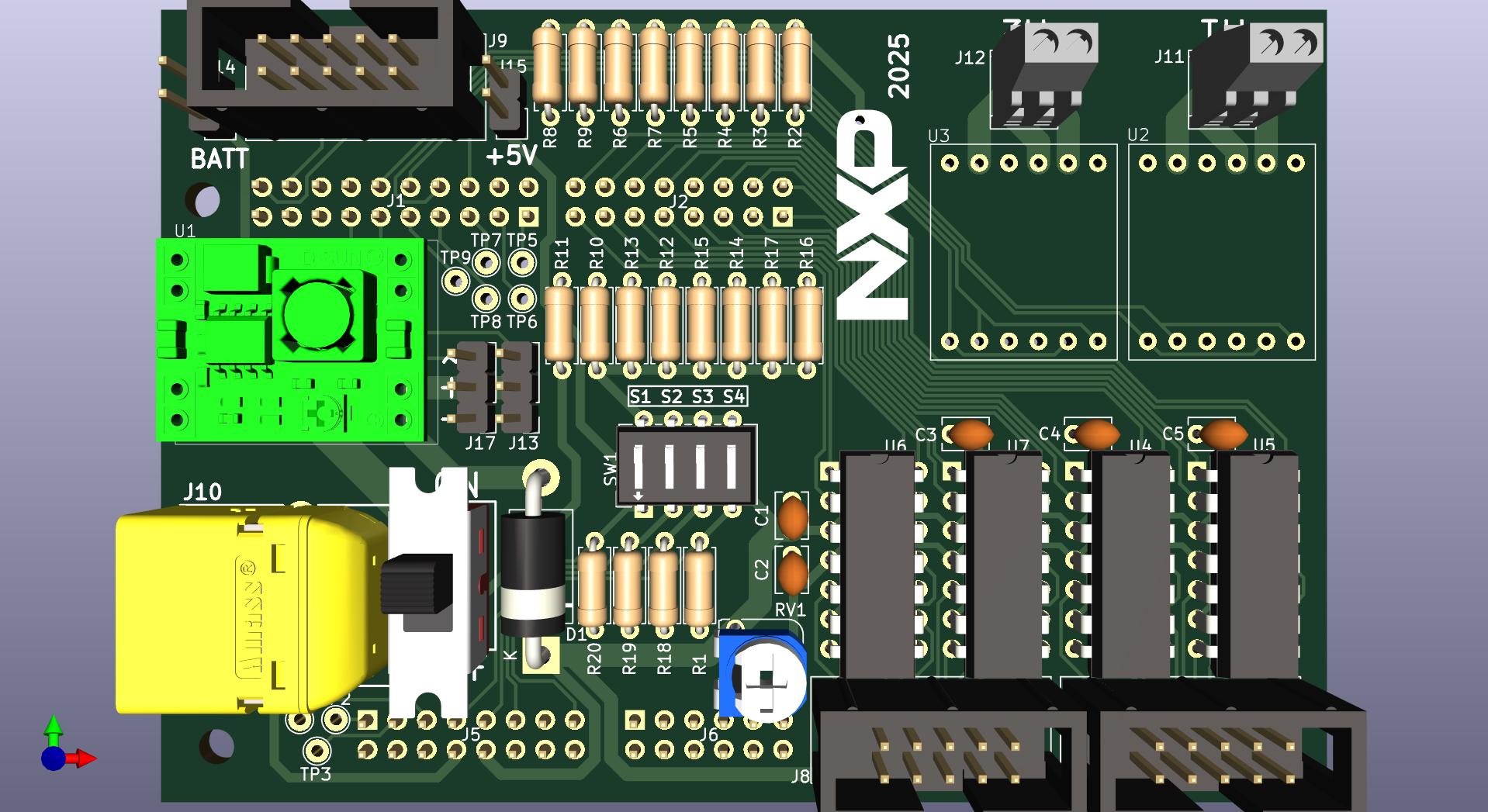 ### Instructions
1. **Identify position** U1 on the PCB
2. **Prepare the MP1584EN module:**
- Check the module pinout: IN+, IN-, OUT+, OUT-
- **⚠️ Verify connections before soldering!**
3. **Position the module:**
- Align the module pins with the PCB pads
- Ensure correct orientation (IN+ to IN+, etc.)
- The module should sit flat or at the designated height
- Connection between power source and shield is made through 4 connectors of 2 pins each
4. **Solder the connections:**
- Solder IN+ pin
- Solder IN- pin
- Solder OUT+ pin
- Solder OUT- pin
- Use sufficient solder for good electrical and mechanical connection
5. **Adjust output voltage (if needed):**
- Before final assembly, you may need to adjust the output voltage
- Use the onboard potentiometer on the MP1584EN
- Set to 5V output (measure with multimeter)
- **⚠️ Verify voltage before mounting any chips or connecting shield to FRDM board!**
### Quality Check
- [ ] MP1584EN module is installed at U1
- [ ] Correct orientation (IN+, IN-, OUT+, OUT- match PCB)
- [ ] All 4 connections are soldered (4 connectors of 2 pins each)
- [ ] Output voltage is set to 5V (if adjustable)
- [ ] Module is mechanically secure
**⚠️ IMPORTANT:** This module converts battery voltage (7.4V) to 5V for the logic circuits. Incorrect wiring can damage components!
---
## Step 15: Mounting Motor Drivers (U2, U3)
### Instructions
1. **Identify position** U1 on the PCB
2. **Prepare the MP1584EN module:**
- Check the module pinout: IN+, IN-, OUT+, OUT-
- **⚠️ Verify connections before soldering!**
3. **Position the module:**
- Align the module pins with the PCB pads
- Ensure correct orientation (IN+ to IN+, etc.)
- The module should sit flat or at the designated height
- Connection between power source and shield is made through 4 connectors of 2 pins each
4. **Solder the connections:**
- Solder IN+ pin
- Solder IN- pin
- Solder OUT+ pin
- Solder OUT- pin
- Use sufficient solder for good electrical and mechanical connection
5. **Adjust output voltage (if needed):**
- Before final assembly, you may need to adjust the output voltage
- Use the onboard potentiometer on the MP1584EN
- Set to 5V output (measure with multimeter)
- **⚠️ Verify voltage before mounting any chips or connecting shield to FRDM board!**
### Quality Check
- [ ] MP1584EN module is installed at U1
- [ ] Correct orientation (IN+, IN-, OUT+, OUT- match PCB)
- [ ] All 4 connections are soldered (4 connectors of 2 pins each)
- [ ] Output voltage is set to 5V (if adjustable)
- [ ] Module is mechanically secure
**⚠️ IMPORTANT:** This module converts battery voltage (7.4V) to 5V for the logic circuits. Incorrect wiring can damage components!
---
## Step 15: Mounting Motor Drivers (U2, U3)
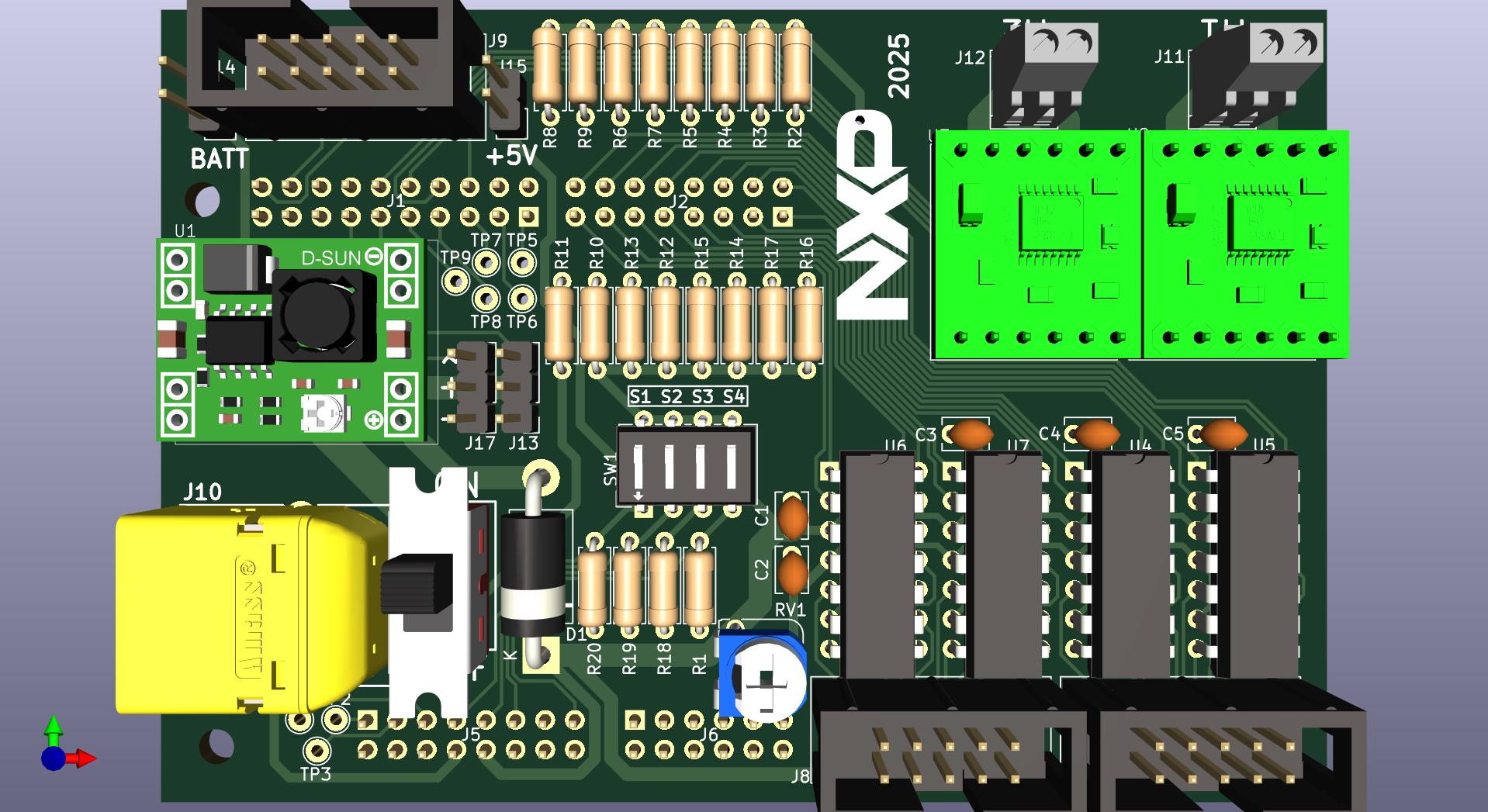 ### Instructions
1. **Identify positions** U2 and U3 on the PCB
2. **Prepare the DRV8833 modules:**
- Each module is a dual H-bridge motor driver
- Check the pinout on the module
- Identify: VCC, GND, IN1, IN2, IN3, IN4, OUT1, OUT2, OUT3, OUT4
3. **Position the first module (U2):**
- Align all pins with the PCB pads
- **⚠️ Verify correct orientation!**
- Ensure the module sits flat or at the correct height
4. **Solder all pins for U2:**
- Solder one corner pin first
- Check alignment
- Solder all remaining pins
5. **Repeat for the second module (U3):**
- Same procedure as U2
6. **Verify connections:**
- Check that power pins (VCC, GND) are correctly connected
- Check that control pins (IN1-IN4) match the PCB design
- Check that output pins (OUT1-OUT4) go to motor terminals
### Quality Check
- [ ] DRV8833 module is installed at U2
- [ ] DRV8833 module is installed at U3
- [ ] Both modules have correct orientation
- [ ] All pins are soldered on both modules
- [ ] No solder bridges between pins
- [ ] Modules are mechanically secure
**Note:** These drivers control the DC motors. U2 controls one motor, U3 controls the other.
---
## Step 16: Inserting LM339 Integrated Circuits (U4-U7)
### Instructions
1. **Identify positions** U2 and U3 on the PCB
2. **Prepare the DRV8833 modules:**
- Each module is a dual H-bridge motor driver
- Check the pinout on the module
- Identify: VCC, GND, IN1, IN2, IN3, IN4, OUT1, OUT2, OUT3, OUT4
3. **Position the first module (U2):**
- Align all pins with the PCB pads
- **⚠️ Verify correct orientation!**
- Ensure the module sits flat or at the correct height
4. **Solder all pins for U2:**
- Solder one corner pin first
- Check alignment
- Solder all remaining pins
5. **Repeat for the second module (U3):**
- Same procedure as U2
6. **Verify connections:**
- Check that power pins (VCC, GND) are correctly connected
- Check that control pins (IN1-IN4) match the PCB design
- Check that output pins (OUT1-OUT4) go to motor terminals
### Quality Check
- [ ] DRV8833 module is installed at U2
- [ ] DRV8833 module is installed at U3
- [ ] Both modules have correct orientation
- [ ] All pins are soldered on both modules
- [ ] No solder bridges between pins
- [ ] Modules are mechanically secure
**Note:** These drivers control the DC motors. U2 controls one motor, U3 controls the other.
---
## Step 16: Inserting LM339 Integrated Circuits (U4-U7)
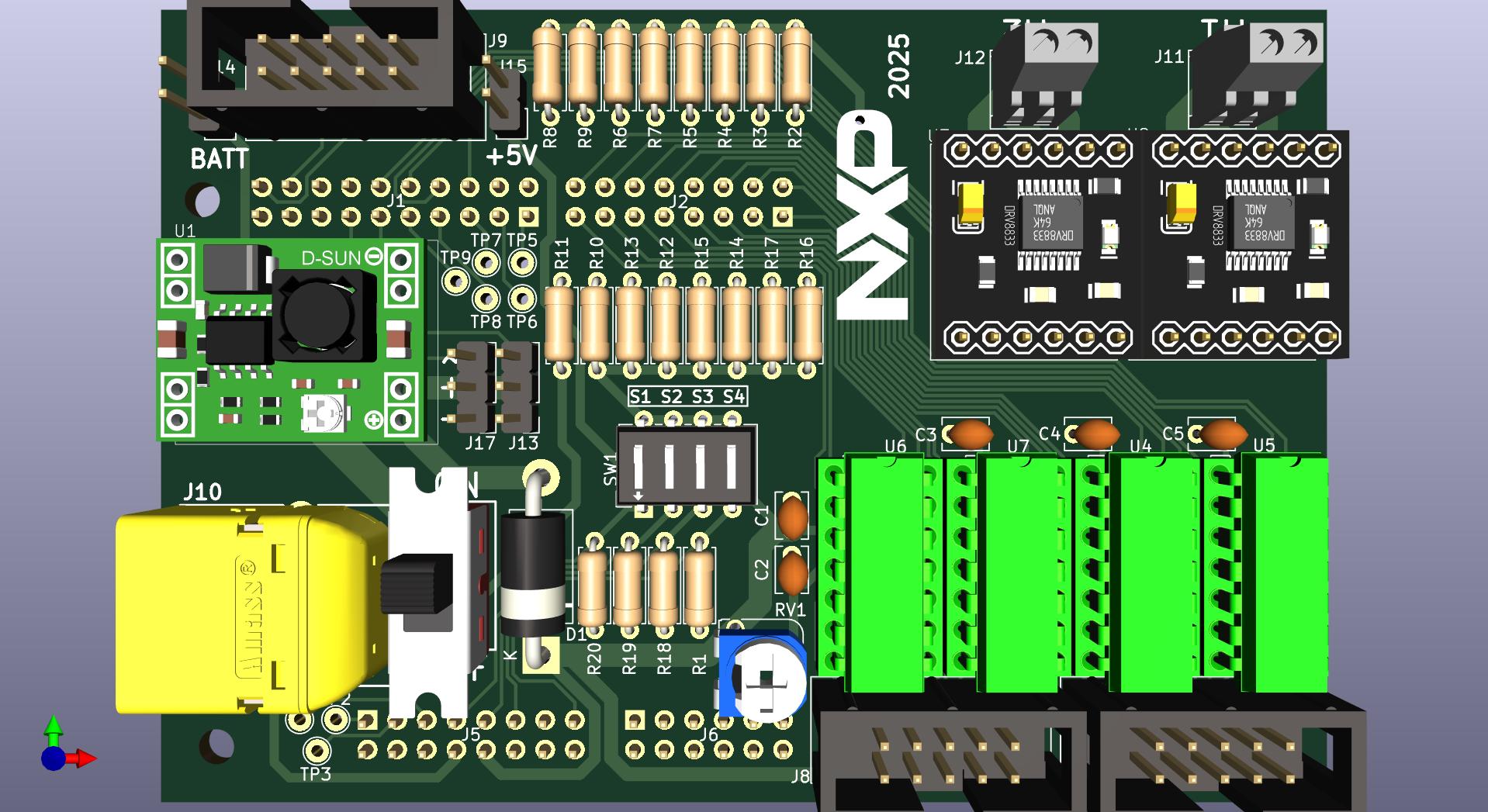 ### Instructions
1. **Prepare the LM339 ICs:**
- Take the 4 LM339 quad comparator ICs
- **⚠️ Handle with care - these are static sensitive!**
- Each IC has 14 pins
2. **Check IC orientation:**
- Each LM339 has a **notch** or **dot** marking pin 1
- The IC sockets (U4-U7) also have notch markings
- **The notch on the IC MUST match the notch on the socket**
3. **Prepare IC pins (if needed):**
- IC pins may be slightly splayed outward
- Gently bend pins inward by pressing the IC sideways on a flat surface
- Pins should be perpendicular to the IC body
4. **Insert the first IC (U4):**
- Align the IC notch with the socket notch
- Align all 14 pins with the socket holes
- Press down gently but firmly
- All pins should enter the socket
- **Do not force!** If a pin bends, remove the IC and straighten the pin
5. **Verify insertion:**
- The IC should sit flat in the socket
- No pins should be bent or outside the socket
6. **Repeat for U5, U6, and U7:**
- Same procedure for each IC
- Always check notch orientation!
### Quality Check
- [ ] LM339 IC is inserted in socket U4 (notch aligned)
- [ ] LM339 IC is inserted in socket U5 (notch aligned)
- [ ] LM339 IC is inserted in socket U6 (notch aligned)
- [ ] LM339 IC is inserted in socket U7 (notch aligned)
- [ ] All ICs sit flat in their sockets
- [ ] No bent pins
- [ ] All pins are in the socket (none outside)
**⚠️ CRITICAL:** Incorrect IC orientation will prevent the circuit from working and may damage the IC when powered!
---
## Step 17: Mounting Jumper
### Instructions
1. **Prepare the LM339 ICs:**
- Take the 4 LM339 quad comparator ICs
- **⚠️ Handle with care - these are static sensitive!**
- Each IC has 14 pins
2. **Check IC orientation:**
- Each LM339 has a **notch** or **dot** marking pin 1
- The IC sockets (U4-U7) also have notch markings
- **The notch on the IC MUST match the notch on the socket**
3. **Prepare IC pins (if needed):**
- IC pins may be slightly splayed outward
- Gently bend pins inward by pressing the IC sideways on a flat surface
- Pins should be perpendicular to the IC body
4. **Insert the first IC (U4):**
- Align the IC notch with the socket notch
- Align all 14 pins with the socket holes
- Press down gently but firmly
- All pins should enter the socket
- **Do not force!** If a pin bends, remove the IC and straighten the pin
5. **Verify insertion:**
- The IC should sit flat in the socket
- No pins should be bent or outside the socket
6. **Repeat for U5, U6, and U7:**
- Same procedure for each IC
- Always check notch orientation!
### Quality Check
- [ ] LM339 IC is inserted in socket U4 (notch aligned)
- [ ] LM339 IC is inserted in socket U5 (notch aligned)
- [ ] LM339 IC is inserted in socket U6 (notch aligned)
- [ ] LM339 IC is inserted in socket U7 (notch aligned)
- [ ] All ICs sit flat in their sockets
- [ ] No bent pins
- [ ] All pins are in the socket (none outside)
**⚠️ CRITICAL:** Incorrect IC orientation will prevent the circuit from working and may damage the IC when powered!
---
## Step 17: Mounting Jumper
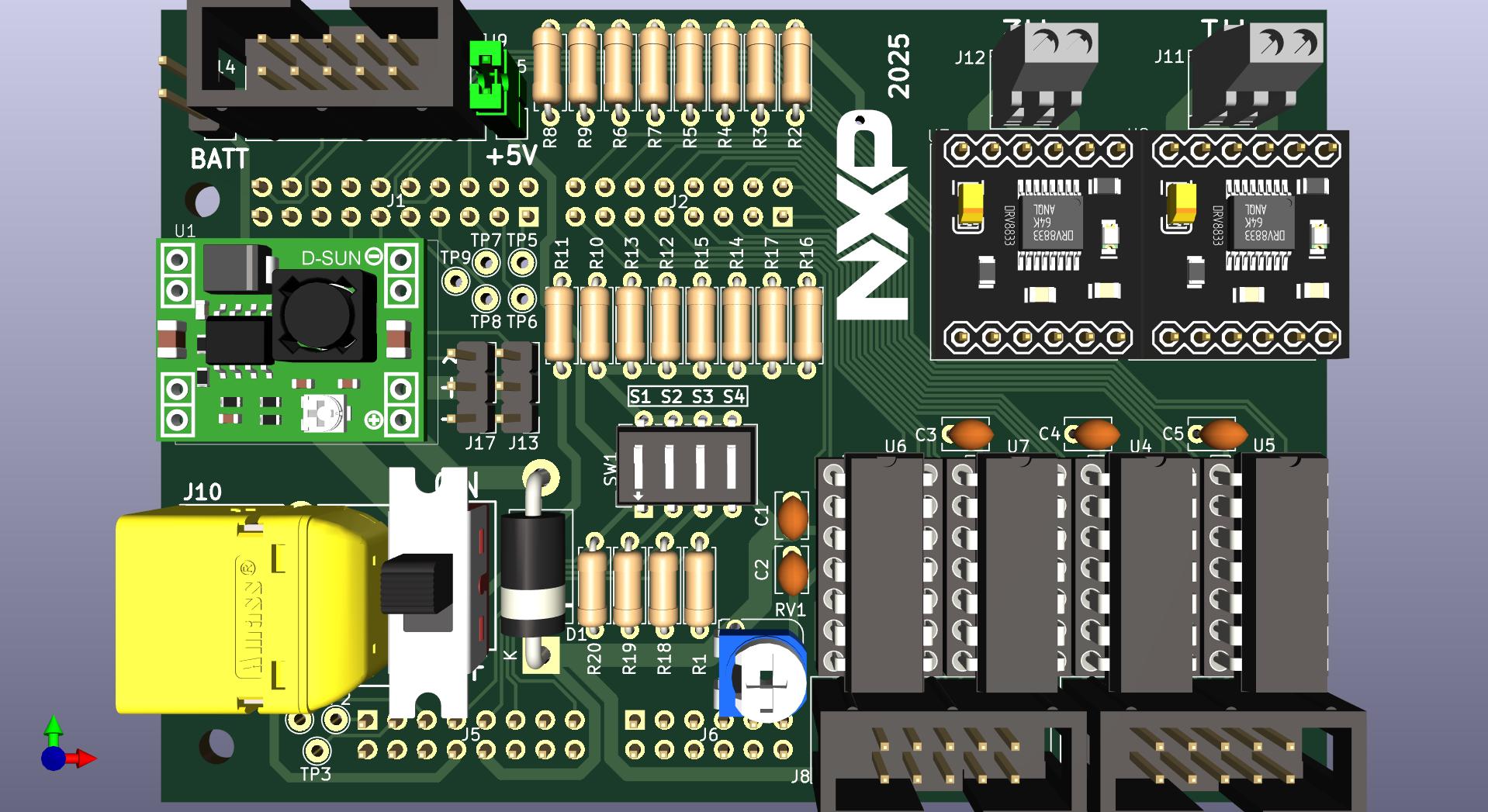 ### Instructions
1. **Identify the jumper position** on the PCB
- Locate connector J15 on the PCB
- This jumper selects the camera power source
2. **Mount the jumper:**
- Place the jumper on J15
- The jumper connects two adjacent pins
3. **Verify configuration:**
- Jumper on J15 selects 5V power for the camera (J9)
- This is the recommended configuration
### Quality Check
- [ ] Jumper is installed on J15
- [ ] Jumper configuration is correct (5V camera power)
**Note:** The jumper on J15 provides 5V power to the camera connector (J9).
---
## Step 18: Final Verification
### Instructions
1. **Identify the jumper position** on the PCB
- Locate connector J15 on the PCB
- This jumper selects the camera power source
2. **Mount the jumper:**
- Place the jumper on J15
- The jumper connects two adjacent pins
3. **Verify configuration:**
- Jumper on J15 selects 5V power for the camera (J9)
- This is the recommended configuration
### Quality Check
- [ ] Jumper is installed on J15
- [ ] Jumper configuration is correct (5V camera power)
**Note:** The jumper on J15 provides 5V power to the camera connector (J9).
---
## Step 18: Final Verification
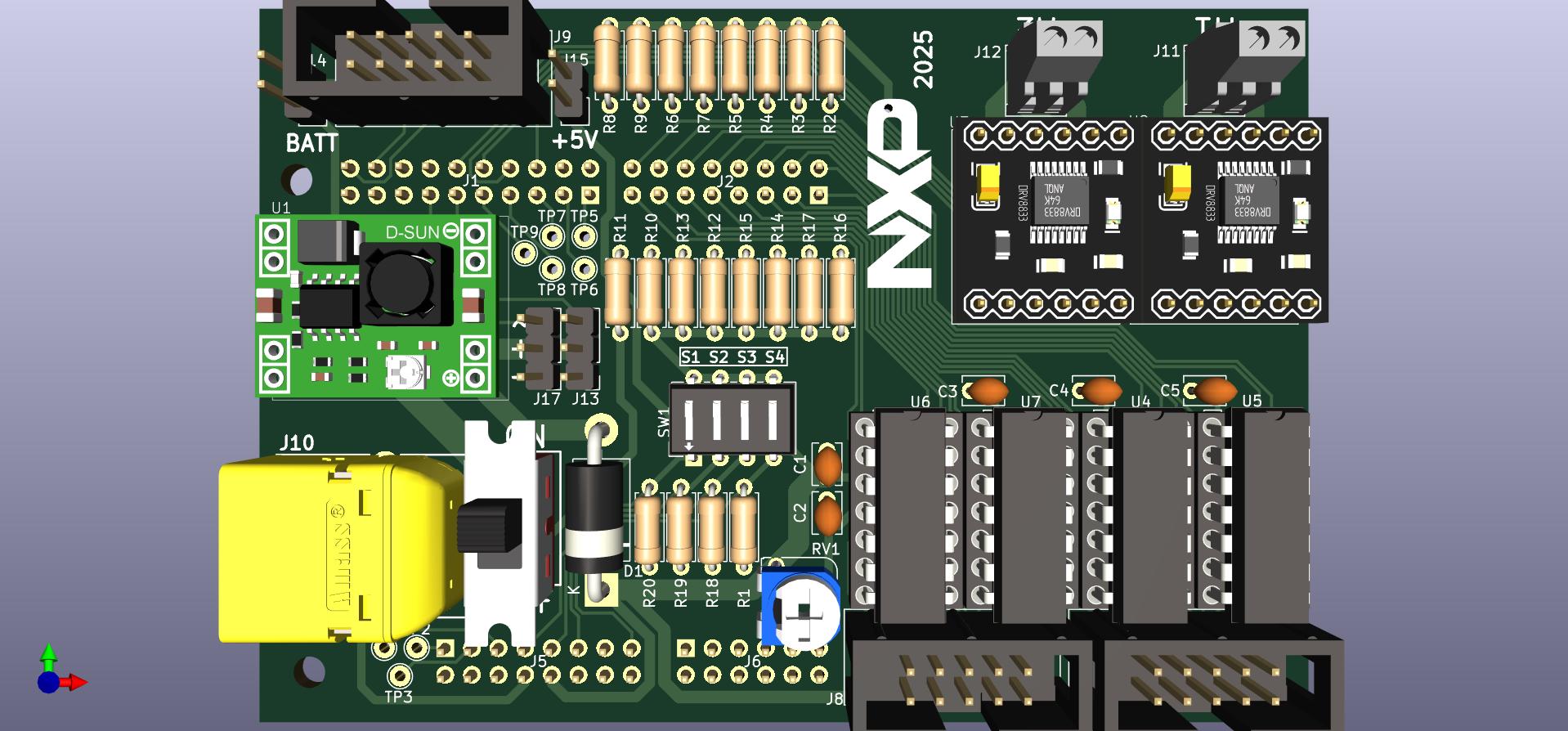
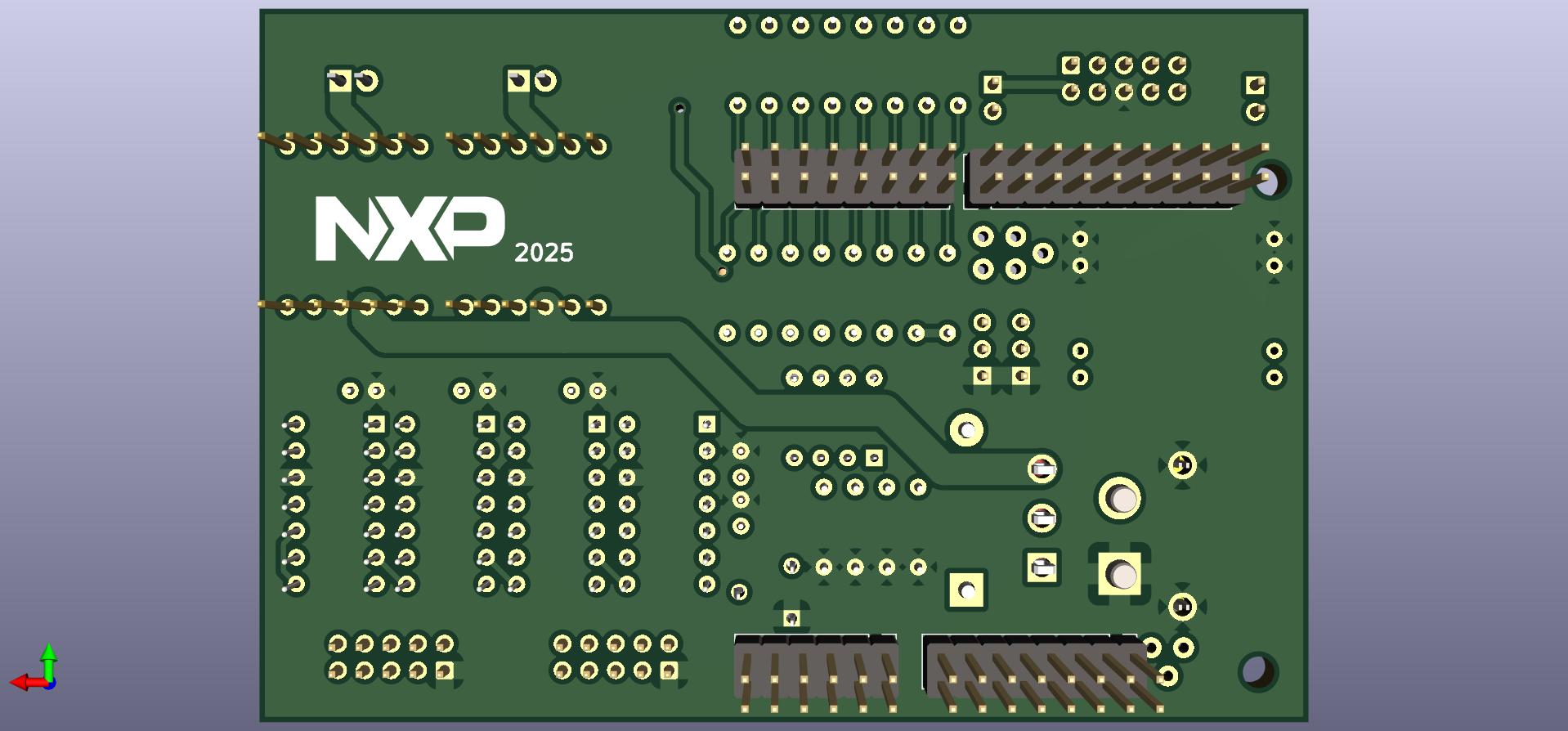 ### Visual Inspection
1. **Component check:**
- [ ] All resistors (R1-R20) are installed
- [ ] All capacitors (C1-C5) are installed
- [ ] Diode D1 is installed with correct polarity
- [ ] All IC sockets (U4-U7) are installed with correct orientation
- [ ] All header connectors (J1, J2, J5, J6) are installed
- [ ] All JTAG connectors (J7-J9) are installed
- [ ] XT60 connector (J10) is installed with correct polarity
- [ ] Screw terminals (J11, J12) are installed
- [ ] All auxiliary connectors (J13-J15, J17) are installed
- [ ] Potentiometer (RV1) is installed
- [ ] Switch (S1) is installed
- [ ] DIP switch (SW1) is installed
- [ ] DC-DC converter (U1) is installed with correct orientation
- [ ] Motor drivers (U2, U3) are installed with correct orientation
- [ ] LM339 ICs are inserted in sockets with correct orientation
- [ ] Jumper is installed
2. **Solder joint inspection:**
- [ ] All solder joints are shiny (not dull or grainy)
- [ ] All joints have a cone shape (not ball-shaped or flat)
- [ ] No cold solder joints
- [ ] No solder bridges between adjacent pins or pads
- [ ] No excess solder creating blobs
- [ ] All component leads are trimmed flush
3. **Component orientation check:**
- [ ] Diode D1 band matches PCB marking
- [ ] IC socket notches match PCB markings
- [ ] LM339 IC notches match socket notches
- [ ] XT60 connector polarity is correct
- [ ] DIP switch position 1 is correctly oriented
- [ ] DC-DC converter IN/OUT connections are correct
- [ ] Motor driver modules are correctly oriented
### Electrical Verification with Multimeter
**⚠️ IMPORTANT:** Perform these tests BEFORE connecting battery!
1. **Continuity test:**
- Set multimeter to continuity mode (beep)
- Test critical connections:
- [ ] GND connections are continuous
- [ ] Power traces are continuous where expected
2. **Short circuit test:**
- Set multimeter to resistance mode
- **Test between power and ground:**
- [ ] Measure resistance between XT60 + and - terminals
- [ ] Should read > 1kΩ (typically several kΩ)
- [ ] If reading is very low (< 100Ω), there may be a short circuit!
- **Test between 5V and GND:**
- [ ] Should also read > 1kΩ
3. **Diode test:**
- Set multimeter to diode test mode
- Test D1:
- [ ] Forward direction should show ~0.3-0.5V (Schottky diode)
- [ ] Reverse direction should show "OL" (open/infinite)
4. **IC socket continuity:**
- Verify that IC socket pins have continuity to their respective PCB traces
- Spot-check a few pins on each socket
### Quality Standards
**Good solder joint characteristics:**
- Shiny, smooth surface
- Cone or volcano shape
- Solder flows onto both pad and component lead
- No gaps or voids
- Adequate but not excessive solder
**Bad solder joint indicators:**
- Dull, grainy appearance (cold joint)
- Ball-shaped (insufficient heating)
- Solder only on lead or only on pad (poor wetting)
- Cracks or fractures
- Excess solder creating bridges
### Troubleshooting Common Issues
**Problem: Cold solder joint**
- Solution: Reheat the joint, ensure both pad and lead are heated
**Problem: Solder bridge between pins**
- Solution: Use desoldering wick to remove excess solder
**Problem: Component not sitting flush**
- Solution: Reheat joint, press component down, let cool
**Problem: Lifted pad**
- Solution: Be very careful! May need to run a jumper wire
**Problem: Short circuit detected**
- Solution: Inspect for solder bridges, check component orientation
---
## Shield Assembly Complete! ✓
Congratulations! You have successfully assembled the NXPCUP-Shield-FRDM-MCXN947.
### Next Steps
The shield is now ready to be mounted on the FRDM-MCXN947 board and integrated into the car chassis.
---
**Next:** [Car Assembly Guide →](car-assembly.md)
[← Shield Components](shield-components.md) | [← Back to Main](../tutorial.md)
### Visual Inspection
1. **Component check:**
- [ ] All resistors (R1-R20) are installed
- [ ] All capacitors (C1-C5) are installed
- [ ] Diode D1 is installed with correct polarity
- [ ] All IC sockets (U4-U7) are installed with correct orientation
- [ ] All header connectors (J1, J2, J5, J6) are installed
- [ ] All JTAG connectors (J7-J9) are installed
- [ ] XT60 connector (J10) is installed with correct polarity
- [ ] Screw terminals (J11, J12) are installed
- [ ] All auxiliary connectors (J13-J15, J17) are installed
- [ ] Potentiometer (RV1) is installed
- [ ] Switch (S1) is installed
- [ ] DIP switch (SW1) is installed
- [ ] DC-DC converter (U1) is installed with correct orientation
- [ ] Motor drivers (U2, U3) are installed with correct orientation
- [ ] LM339 ICs are inserted in sockets with correct orientation
- [ ] Jumper is installed
2. **Solder joint inspection:**
- [ ] All solder joints are shiny (not dull or grainy)
- [ ] All joints have a cone shape (not ball-shaped or flat)
- [ ] No cold solder joints
- [ ] No solder bridges between adjacent pins or pads
- [ ] No excess solder creating blobs
- [ ] All component leads are trimmed flush
3. **Component orientation check:**
- [ ] Diode D1 band matches PCB marking
- [ ] IC socket notches match PCB markings
- [ ] LM339 IC notches match socket notches
- [ ] XT60 connector polarity is correct
- [ ] DIP switch position 1 is correctly oriented
- [ ] DC-DC converter IN/OUT connections are correct
- [ ] Motor driver modules are correctly oriented
### Electrical Verification with Multimeter
**⚠️ IMPORTANT:** Perform these tests BEFORE connecting battery!
1. **Continuity test:**
- Set multimeter to continuity mode (beep)
- Test critical connections:
- [ ] GND connections are continuous
- [ ] Power traces are continuous where expected
2. **Short circuit test:**
- Set multimeter to resistance mode
- **Test between power and ground:**
- [ ] Measure resistance between XT60 + and - terminals
- [ ] Should read > 1kΩ (typically several kΩ)
- [ ] If reading is very low (< 100Ω), there may be a short circuit!
- **Test between 5V and GND:**
- [ ] Should also read > 1kΩ
3. **Diode test:**
- Set multimeter to diode test mode
- Test D1:
- [ ] Forward direction should show ~0.3-0.5V (Schottky diode)
- [ ] Reverse direction should show "OL" (open/infinite)
4. **IC socket continuity:**
- Verify that IC socket pins have continuity to their respective PCB traces
- Spot-check a few pins on each socket
### Quality Standards
**Good solder joint characteristics:**
- Shiny, smooth surface
- Cone or volcano shape
- Solder flows onto both pad and component lead
- No gaps or voids
- Adequate but not excessive solder
**Bad solder joint indicators:**
- Dull, grainy appearance (cold joint)
- Ball-shaped (insufficient heating)
- Solder only on lead or only on pad (poor wetting)
- Cracks or fractures
- Excess solder creating bridges
### Troubleshooting Common Issues
**Problem: Cold solder joint**
- Solution: Reheat the joint, ensure both pad and lead are heated
**Problem: Solder bridge between pins**
- Solution: Use desoldering wick to remove excess solder
**Problem: Component not sitting flush**
- Solution: Reheat joint, press component down, let cool
**Problem: Lifted pad**
- Solution: Be very careful! May need to run a jumper wire
**Problem: Short circuit detected**
- Solution: Inspect for solder bridges, check component orientation
---
## Shield Assembly Complete! ✓
Congratulations! You have successfully assembled the NXPCUP-Shield-FRDM-MCXN947.
### Next Steps
The shield is now ready to be mounted on the FRDM-MCXN947 board and integrated into the car chassis.
---
**Next:** [Car Assembly Guide →](car-assembly.md)
[← Shield Components](shield-components.md) | [← Back to Main](../tutorial.md)